
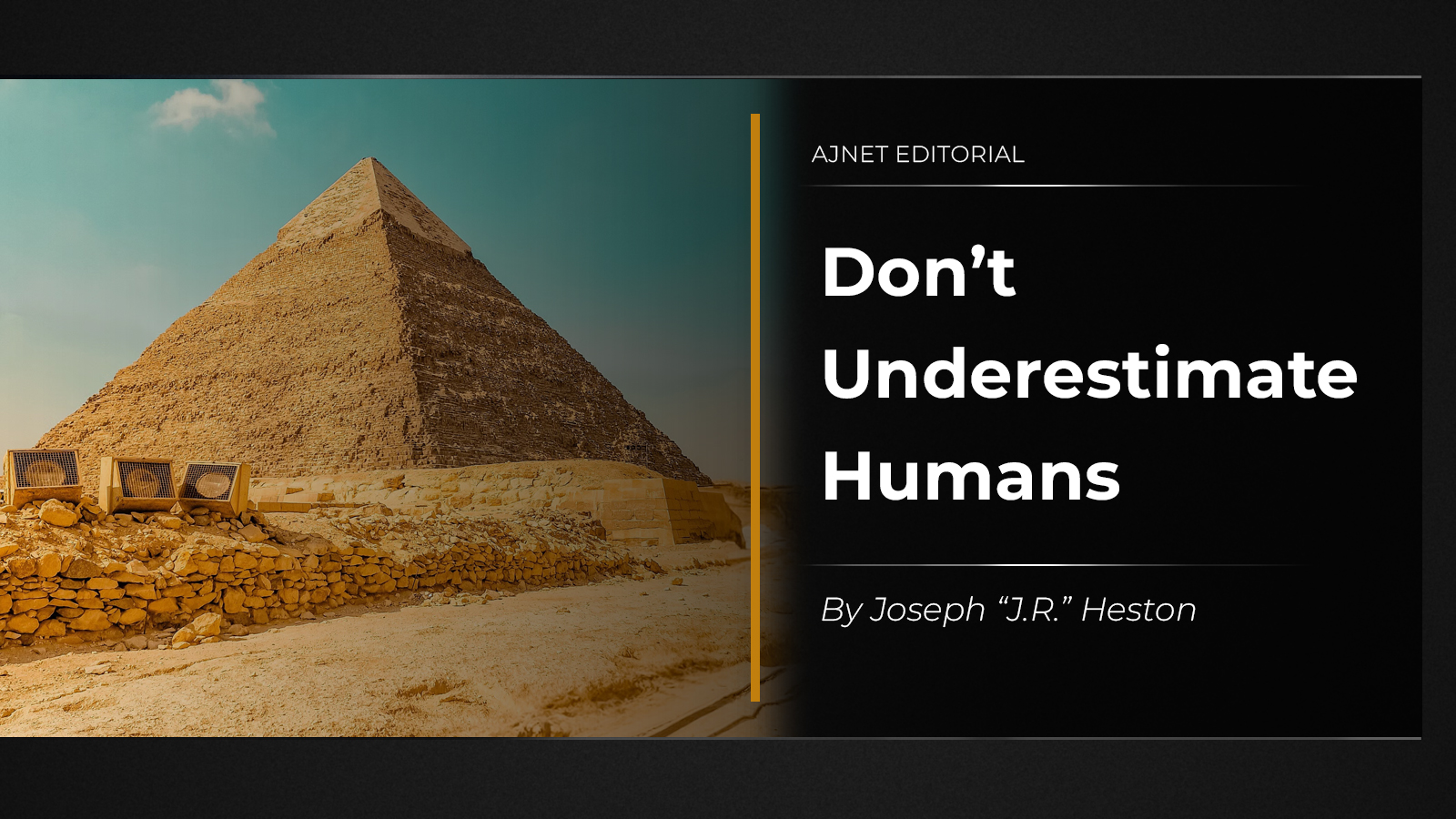
Every year, without fail, at least one idiot in one of my classes asks whether aliens built the pyramids.
It usually happens after I’ve spent half the lesson explaining ancient Egyptian engineering, religion, government, and the massive organization required to construct these monuments. Instead of absorbing any of that information, some little shit looks up from his phone and says, “But how do we know aliens didn’t do it?”
Because we have archaeological evidence, you nitwit.
We have the quarries. We have the tools. We have workers’ settlements. We have inscriptions left behind by labor crews. We have partially completed structures that show how construction methods developed over time. We can trace the gradual improvement of Egyptian architecture from simple burial mounds to mastabas, step pyramids, and eventually the enormous monuments at Giza.
But none of that matters to people who would rather watch a badly produced television show about aliens.
Idiots have a habit of underselling what historical humans were capable of. Instead of learning actual history and giving their ancestors credit for their intelligence, skill, patience, and hard work, they assume anything impressive must have been constructed with help from outer space.
Ancient people couldn’t possibly have built that.
They didn’t have power tools!
They didn’t even have trucks!
How could anyone move a rock without a forklift?
This is what you people don’t understand. These great projects took time, skill, motivation, organization, and effort, all things ancient humans possessed in abundance. It’s amazing what human beings can accomplish when they aren’t glued to a fucking phone for fourteen hours a day mindlessly watching TikTok.
Then there’s that guy with the crazy hair from the History Channel, George whatever the fuck his name is.
This clown has made an entire career out of peddling bullshit about ancient aliens. Every time archaeologists find a carved rock, unusual structure, or piece of artwork, this man comes flying in with his hair standing straight up to ask whether extraterrestrials were responsible.
Did aliens visit Earth thousands of years ago? I don’t know. I wasn’t there. The universe is enormous, so I’m not arrogant enough to declare that life exists only on our planet.
But I guarantee that if aliens flew across the unimaginable vastness of space to visit ancient Earth, they didn’t come here to teach humans how to stack rocks. Imagine developing technology capable of crossing multiple solar systems, only to land in Egypt and start giving masonry lessons. You can manipulate time and space, but your great contribution to humanity is showing some guys how to drag limestone up a ramp.
Why is this crap even on the History Channel?
The History Channel used to show documentaries about wars, presidents, empires, inventions, and ancient civilizations. Now half its programming seems to consist of pawn shops, storage lockers, and some lunatic suggesting that every religious painting contains a hidden spaceship.
Why not show actual history? The truth behind these structures is already fascinating. Humans carved enormous stones using relatively basic tools, transported them across considerable distances, and assembled monuments that survived for thousands of years. Apparently that isn’t exciting enough unless a flying saucer gets added to the story.
Let me explain something to you.
Aliens didn’t build the pyramids. Humans built the pyramids.
Most of the limestone used for the Great Pyramid came from local quarries, while finer casing stone and granite were transported from farther away, sometimes by boat along the Nile. Workers hauled blocks on wooden sledges, and evidence suggests that dampening the sand in front of a sledge could substantially reduce the force needed to pull it. The stones were then raised using some arrangement of ramps, ropes, levers, and coordinated manpower, although historians still debate the precise ramp design. Most importantly, the workforce included organized labor crews and skilled craftsmen who were housed, fed, and compensated, not the giant army of chained slaves commonly depicted in movies.
Was it easy?
Of course it wasn’t easy. It was a massive state project that took years of planning and physical labor. That doesn’t make it impossible. It means that the Egyptians were extremely good at organizing large numbers of people around a shared objective.
They also had generations of experience.
The Great Pyramid didn’t suddenly appear because some Egyptian woke up one morning and decided to construct the largest stone structure anyone had ever seen. Egyptian builders learned from earlier projects. Some pyramids partially collapsed, developed structural problems, or were built at angles that had to be altered during construction. The methods improved over time because ancient builders were capable of observation, experimentation, and learning from failure.
You know, the same basic process behind almost every technological advancement in human history.
The moai of Rapa Nui, commonly called the Easter Island heads even though many of them have full bodies, receive the same insulting treatment. Impressionable idiots see these statues spread across the island and immediately assume aliens must have helped move them.
One leading explanation is that the Rapa Nui people transported the statues upright using ropes attached from multiple sides. Teams pulled alternately from the left and right while another group stabilized the statue from behind, causing it to rock forward in small steps as though it were walking. Modern experiments using replicas have demonstrated that relatively small groups can move heavy statues this way, and the shape of many moai appears compatible with the technique. Other transportation theories involving sledges and rollers have also been proposed, so nobody should pretend every detail is settled. What is clear is that moving them required human coordination and ingenuity, not an alien antigravity beam.
People dramatically underestimate what groups of determined humans can accomplish using ropes, leverage, and repetition. It’s not rocket science to move a big rock. You shift it a little, secure it, shift it again, and continue until it reaches its destination. The process might take weeks or months, but ancient people weren’t in a hurry to get home so they could watch Netflix. They had plenty of time.
They also had motivation. The moai represented important ancestors and carried immense cultural and spiritual significance to the people constructing them. When a society genuinely believes a monument protects the community, honors its ancestors, or earns favor from higher powers, people tend to become extremely motivated to finish the damn thing.
The claim that aliens created Stonehenge is even stupider.
Stonehenge is a circle of rocks. It’s an extremely impressive, carefully planned circle of rocks, but the underlying concept isn’t beyond human comprehension. Early humans understood circles. They understood holes. They understood that if you dug a hole, raised a large stone into it, and packed the base tightly enough, the stone would remain standing.
Stonehenge was built in stages over many centuries rather than appearing as one completed monument overnight. Its smaller bluestones were transported from Wales through some combination of land and water travel, while the enormous sarsen stones were hauled from a more local source on heavy wooden sledges. Builders shaped the stones, dug prepared pits, and used ropes, wooden frames, levers, and packed earth to raise them upright. The horizontal lintels were lifted into place and secured using carefully carved joints, showing that the builders possessed serious woodworking and stoneworking knowledge. None of this required antigravity technology, only planning, labor, and a group of people who knew what the hell they were doing.
Ancient humans weren’t stupid. They didn’t have cellphones, cars, electric saws, or computer simulations, but they understood their environment in ways most modern people never will. They knew how to identify useful stone, make rope from plants, move enormous loads, follow the seasons, navigate by the sky, and coordinate large groups without sending calendar invitations.
Meanwhile, today I have students who can’t figure out how to open a PDF.
Our ancestors lacked the conveniences we take for granted, which meant they had no choice but to become more resourceful. When something broke, they repaired it. When they needed a tool that didn’t exist, they made one. When a method failed, they adjusted it and tried again.
Over generations, those small improvements accumulated. Better stone tools led to metal tools. Better farming methods supported larger populations. Larger populations created cities, governments, specialized trades, writing systems, roads, armies, and increasingly ambitious construction projects.
Eventually, that long chain of human problem-solving created the society we live in today.
Modern people often mistake technological convenience for intelligence. We assume we’re smarter because we carry devices containing most of humanity’s accumulated knowledge in our pockets. Yet half the population uses that technology to watch fifteen-second videos of people dancing, arguing, or eating detergent pods.
Having access to information doesn’t mean you understand any of it.
Ancient people may not have known how electricity worked, but many modern people don’t know either. They simply know that when they press a button the light turns on. Take away electricity, running water, supermarkets, motor vehicles, and the internet, and most people today would be dead or begging for help within a week.
Never underestimate ancient humans, especially when religious devotion is involved.
Belief in gaining the favor of a god was one hell of a motivator for getting shit done. If an entire society believed that constructing a temple, tomb, or monument would ensure fertile crops, protect the kingdom, honor the dead, or secure eternal life, they were going to find a way to move those heavy-ass rocks.
There’s an old saying: Hard times create strong men. Strong men create good times. Good times create weak men. Weak men create hard times.
I think it’s pretty easy to see which part of that cultural cycle we’re currently living through.
We inherited the good times created by thousands of years of people solving problems, surviving disasters, building civilizations, and gradually improving upon the work of earlier generations. Our response has been to become so detached from basic physical labor and practical problem-solving that we think a stone weighing several tons can only be moved by aliens.
I’m not saying aliens don’t exist, because I believe they probably do. I’m saying you should give your ancestors the credit they deserve.
Humans built the pyramids. Humans carved and moved the moai. Humans constructed Stonehenge. They accomplished these things through ingenuity, devotion, organization, hard labor, and an amount of patience modern people can barely comprehend.
No spaceships were required. Just stronger people with longer attention spans.

More from J. R. Heston


Don't miss any new posts. Join AJnet Magazine's mailing list and receive updates straight to your inbox once a week!