
How is this legal?
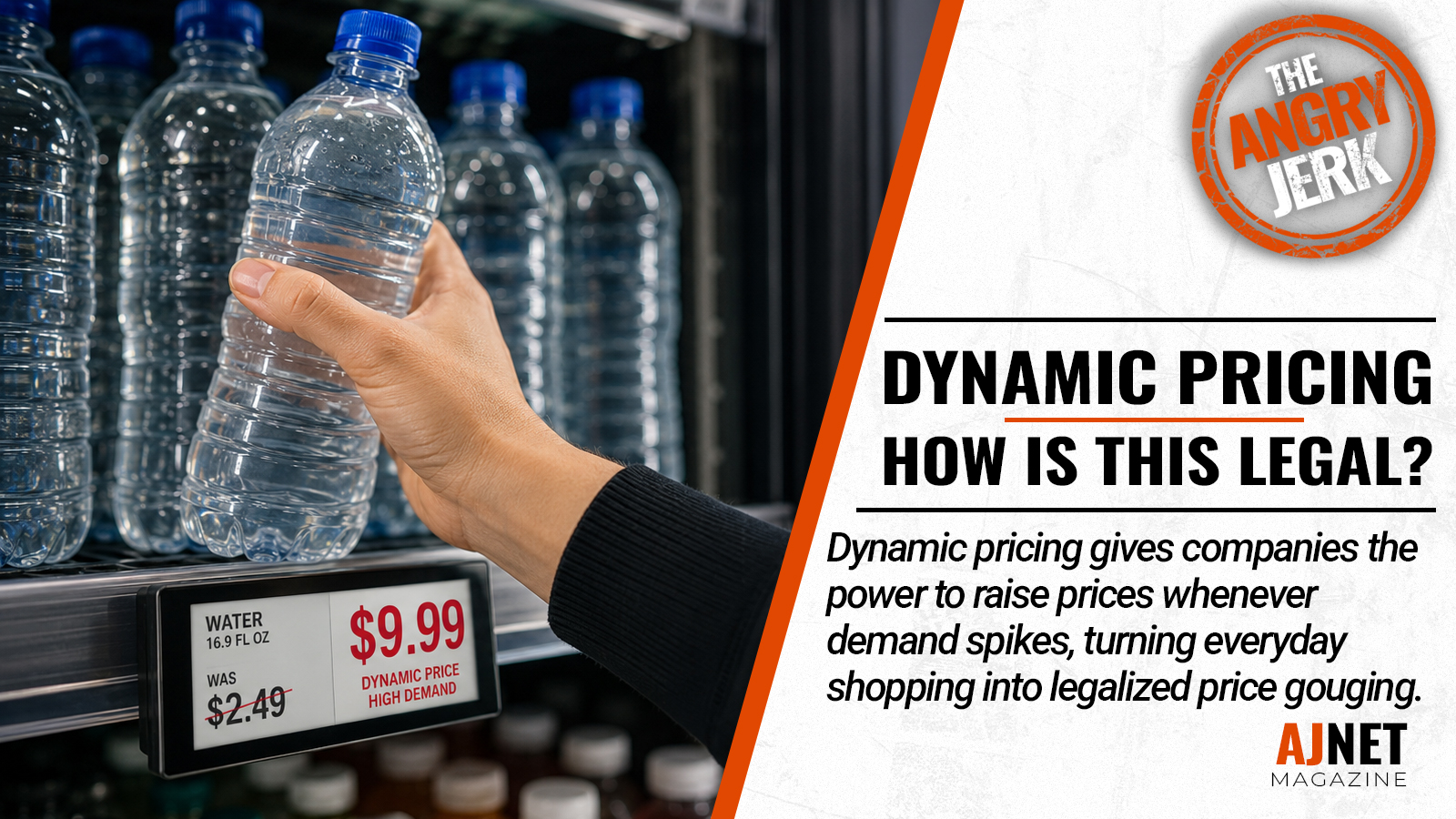
Imagine walking into a convenience store on a 100-degree day to buy a bottle of water. The price on the shelf says $2.49, which is already more than anyone should be paying for something that falls out of the sky for free. You grab the bottle, walk around the store for a few minutes, then bring it to the register.
“That’ll be $9.99.”
What the fuck happened?
Well, it’s hot outside, everyone is thirsty, and the store’s pricing algorithm noticed that bottled water is selling faster than usual. The price increased between the time you picked it up and the time you reached the register. Guess you should’ve walked faster.
Welcome to the wonderful world of dynamic pricing.
Dynamic pricing is a system where the price of a product or service changes based on factors like demand, inventory, location, time of day, or whatever other information a company feeds into an algorithm. We already deal with it when buying airline tickets, booking hotel rooms, calling an Uber, or trying to attend a sporting event. The more people who want something at a particular moment, the more expensive it becomes.
There’s also surveillance pricing, an even more invasive version where companies use personal information to decide what an individual customer might be willing to pay. The Federal Trade Commission found that pricing companies can use information such as location, demographics, browsing history, shopping behavior, abandoned online carts, and even mouse movements to help retailers tailor prices and promotions. Two people could theoretically shop for the exact same product and be shown different prices because an algorithm decided one of them could be squeezed a little harder.
I don’t care what consumer-friendly bullshit companies use to describe this. Dynamic pricing is the textbook definition of highway robbery.
Retailers will insist that the technology has legitimate uses. Electronic shelf labels allow stores to change prices without making an employee walk through every aisle replacing paper tags. They can correct errors faster, mark down food that’s nearing its expiration date, update sales, and keep the price at the register consistent with the price displayed on the shelf.
All of that sounds reasonable.
But there’s just one teensy little problem: there’s no way companies won’t eventually use the same technology to fuck consumers over.
These companies can’t resist shrinking packages while raising prices. They can’t resist charging fees on top of other fees. They can’t resist putting basic features behind subscriptions or making customers surrender personal information to receive the price everyone used to get automatically. Now we’re supposed to trust them with technology that allows them to change thousands of prices in seconds?
Yeah, I’m sure that’ll go well.
The defenders of dynamic pricing will argue that stores already change prices and this technology only makes the process more efficient. That’s technically true, but efficiency is exactly what worries me. A store changing its prices once a week gives customers some degree of stability. A store capable of changing them every ten minutes can react to every little surge in demand and turn ordinary shopping into a speculative market.
No more having to wait an entire week to bend your customers over the table. Now you can do it on the fly thanks to dynamic pricing!
It’ll be like concession stand prices, except everywhere. Bottled water costs more when it’s hot. Cold medicine shoots up during flu season. Batteries and flashlights double in price when a storm is approaching. Burgers become more expensive around lunchtime because the algorithm noticed people tend to eat around noon.
Companies will call this “responding to market conditions.” Everyone else will call it getting fucked.
There’s also a major practical problem here. What price am I actually agreeing to pay when I remove something from the shelf?
Suppose I pick up a box of cereal marked $4.99. While I’m walking toward the register, the digital shelf label changes to $6.49. Does the store charge me the price that was displayed when I placed it in my cart, or does the register automatically charge the new price? How do I prove what the original price was? Am I expected to photograph every shelf label before picking something up? Does the store need cameras tracking the exact second each customer removes an item? Will an employee have to review security footage because I’m disputing a $1.50 increase on a box of Frosted Flakes?
This gets even more ridiculous when you consider a crowded grocery store where dozens of people may have picked up the same item at different times and each saw different prices. The technological infrastructure required to implement this fairly would be unnecessarily complicated, which means stores probably won’t bother. They’ll charge whatever price appears in the system when the item gets scanned and tell customers to either pay it or put the product back.
Will it work the other way too?
Suppose the cereal costs $4.99 when I pick it up, but the algorithm lowers it to $3.99 before I reach the register. Do I get the lower price? I’d like to believe so, but corporate technology has a funny way of functioning perfectly whenever it takes money from you and mysteriously malfunctioning whenever it owes you something.
Some states have started moving against these practices. Maryland passed the Protection From Predatory Pricing Act, which takes effect October 1, 2026. The law prohibits covered food retailers and third-party delivery services from using personal data to raise the price of certain food for a specific customer. It doesn’t ban every form of demand-based pricing, but it at least recognizes that allowing grocers to personalize price increases is predatory. Similar restrictions have been considered or enacted elsewhere as states begin examining algorithmic and surveillance pricing.
How is this even a debate?
There is no legitimate reason why two customers should pay different prices for the same gallon of milk, in the same store, at the same time, because one of them lives in a wealthier neighborhood or has a shopping history suggesting they’ll tolerate the higher price. That isn’t competition or supply and demand. It’s a company using surveillance to determine exactly how much money it can extract from each person. At this point, I might as well hand these companies my fucking wallet and let them have everything. Cut out the middleman and save us all some time. Here, just take it all, you greedy fucking bastards.
When is enough enough? Consumers have been dealing with inflation, shrinkflation, hidden fees, subscription creep, rent increases, insurance increases, and every other creative method corporations have developed to drain our bank accounts. People are beyond dry, yet these companies are still sitting around brainstorming new ways to wring out the last few drops.
The bigger issue is that there’s rarely any meaningful punishment when companies cross the line.
Three major egg producers recently agreed to pay $3.3 million and donate 53 million eggs to settle allegations that they manipulated a widely used egg-price benchmark between 2022 and 2025. As of this writing, the agreement still requires court approval, and the companies didn’t admit wrongdoing. Still, Cal-Maine Foods alone reported approximately $1.22 billion in profit during fiscal year 2025. Against numbers like that, a few million dollars seems less like a punishment and more like a processing fee.
We’re supposed to believe a settlement like that will scare anyone?
A separate class-action lawsuit filed in June accuses Samsung, SK Hynix, and Micron of coordinating reductions in conventional computer-memory production to drive up DRAM prices. So far, those are only allegations, not proven facts, but the pattern is familiar: a handful of companies control most of a market, prices suddenly explode, consumers get screwed, and years later some lawsuit might result in a settlement that barely dents the profits received.
At this point, breaking antitrust laws can become a profitable business strategy. Make billions, get caught years later, pay a comparatively tiny fine, promise not to do it again, then return to business as usual. It’s the financial equivalent of receiving ten lashes from a wet noodle. The punishment is treated as a business expense because the people who made the decisions rarely suffer any personal consequences.
Fuck the fines, let’s start giving executives actual prison sentences when prosecutors can prove they knowingly coordinated prices or used illegal schemes to defraud consumers. Seize the money the company made from the misconduct instead of negotiating a settlement worth a fraction of the profits. Ban the people responsible from serving as corporate officers again.
As much as I despise the Chinese government, they’ve got one thing right. When companies fuck up, they get held accountable. CEOs over there get executed for pulling this kind of shit. I wouldn’t object to implementing a similar concept here in America. Imagine if, instead of being slapped on the wrist with that measly little $3.3 million fine, the CEOs of those egg companies had to face a firing squad. I think a lot of companies might shape up real quick when faced with the prospect of actual consequences for breaking the law.
Now, I’m not seriously proposing that we line CEOs up in front of firing squads, tempting as that mental image might become when you’re staring at a $6 carton of eggs. We already have a functional alternative called prison. The problem is that white-collar criminals are treated like respectable businesspeople who made an accounting error instead of thieves who stole money from millions of households. On the off-chance they actually do go to prison, it’s usually some Club Fed-style prison that might as well just be an extended stay at the Hilton.
Until there are real consequences, companies will keep testing how much they can get away with. Dynamic pricing gives them another powerful tool to do it, except this time the price gouging can happen instantly and be disguised behind an algorithm.
A price should be a price. Stores can run sales, offer coupons, mark down old inventory, and adjust prices when their actual costs change. What they shouldn’t be allowed to do is watch customers, measure demand in real time, calculate how desperate someone might be, and quietly charge more because the computer believes they’ll pay it.
I’m not encouraging anyone to commit crimes, but if I see someone shoplifting from a store that uses dynamic pricing, then no I didn’t.

More from Angry_Jerk


Don't miss any new posts. Join AJnet Magazine's mailing list and receive updates straight to your inbox once a week!
Dynamic pricing is legal because your corporate overlords said so. Now be a good little wage slave and do a TikTok dance for your manager.
I’m my own boss and I don’t have TikTok, so I danced to “Tik Tok” by Kesha in front of a mirror. Will that suffice?