
I spend a lot of time exercising.
Currently, I lift weights four days a week, run several times a week, and regularly go out for ten-mile runs on Saturday mornings. I pay attention to calories, protein, carbohydrates, and all that other crap because right now I’m trying to lose weight without sacrificing too much muscle or running myself into the ground. I’m probably more obsessive about this stuff than the average person needs to be, and even I think people make fitness way more complicated than it really is.
Whatever happened to just exercising and eating right?
Every person online seems to have some crazy routine they swear by, some revolutionary meal plan that changed their life, or some tub of overpriced powder they conveniently have a discount code for. You can’t look up a basic exercise without finding ten guys arguing over which variation provides three percent more muscle activation. You can’t look up a healthy breakfast without someone trying to explain the glycemic index, nutrient bioavailability, insulin sensitivity, and the precise time of day you should eat a fucking blueberry.
The fitness industry has become a bunch of convoluted bullshit.
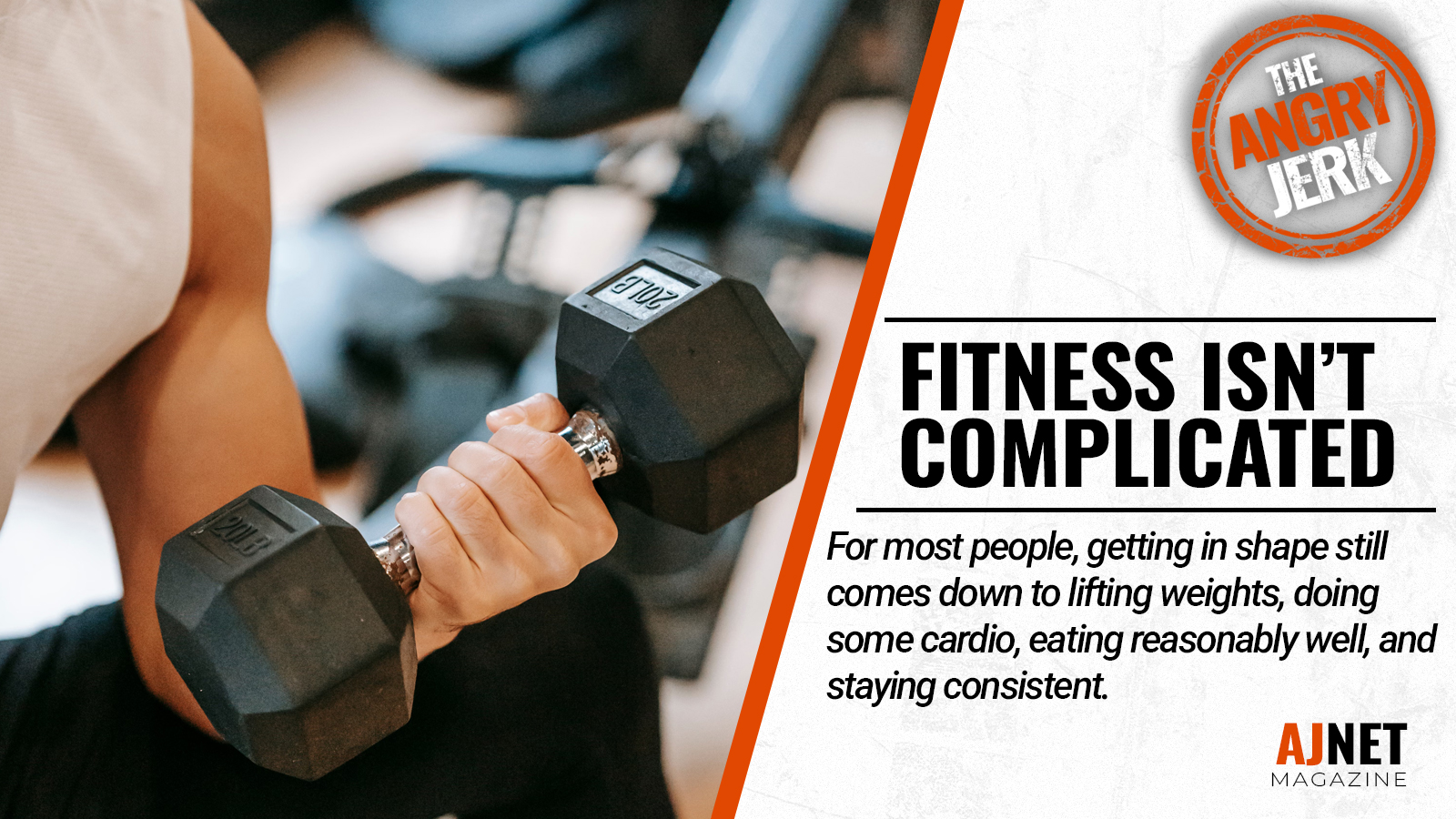
Getting into shape really is simple for most people. Exercise regularly, eat relatively well, and adjust how much you eat based on whether you’re trying to gain or lose weight. If you want to build muscle, lift weights and gradually increase either the weight or the amount of work you’re doing. If you want to improve your endurance and cardiovascular health, do some cardio. Try not to survive entirely on fast food and soda.
There you go. I just gave you the ultimate secrets of fitness in five sentences. You’re welcome.
Now, obviously, there are exceptions. Someone training for a bodybuilding competition, running a marathon, recovering from a serious injury, or dealing with a medical condition is going to require a more specialized approach. But the average person trying to lose twenty pounds and stop getting winded while carrying groceries up the stairs doesn’t need the same level of planning as a professional athlete. People get so hung up on the smallest details that they completely lose focus on the basics. They worry about macronutrients, micronutrients, simple carbs, complex carbs, metabolic windows, protein timing, and the absorption rate of seventeen different supplements. Meanwhile, they exercise once every two weeks and order from DoorDash for dinner every night.
You’re worrying about the wrong shit, dude.
It doesn’t matter whether you drink your protein shake twelve minutes or forty minutes after your workout if you barely worked out in the first place. It doesn’t matter whether white rice is theoretically worse than brown rice if you eat three servings of it and wash it down with a milkshake. You don’t need to debate the optimal number of weekly sets for your chest when you keep skipping chest day because you’re tired.
Consistency matters more than all of this minutiae. A half-decent workout routine that you follow for years will do more for you than the perfect routine that you abandon after three weeks. Eating reasonably well most of the time will do more than following some hyper-restrictive meal plan until you get tired of plain chicken and broccoli and inhale an entire pizza.
This is where fitness advice starts to become actively unhelpful. People who are already in exceptional shape begin dispensing advice based on what helped them squeeze out the final few percentage points of performance, and average people assume they need to follow the same routine. They see a bodybuilder measuring every grain of rice and think they need to start carrying a food scale to family dinners. You’re not going to be the next Mr. Olympia.
I don’t mean that as an insult. Almost nobody is going to be the next Mr. Olympia. The people who compete at that level generally started training young, have exceptional genetics, dedicate their entire lives to bodybuilding, and take anabolic steroids. You can copy their workouts, eat the same meals, take the same supplements, and inject the same stuff into your ass, and you still probably won’t look like them.
For example, Arnold Schwarzenegger started lifting when he was about fifteen years old. He had great genetics, trained like a lunatic, and openly used steroids during a time when nobody really cared. He was among the best in the world at what he did. Comparing your results to Arnold makes about as much sense as going for a jog around the neighborhood and wondering why you aren’t Usain Bolt.
Most people don’t need to look like Arnold anyway. They need to lose some fat, build a little muscle, and improve their general health. You can accomplish all of that without turning fitness into a second job.
Then there’s “science-based lifting.”
What the fuck even is science-based lifting?
I understand the basic idea. Instead of blindly trusting gym folklore, people look at scientific research to determine which exercises and training methods tend to work best. There’s nothing inherently wrong with that. Research can help improve exercise technique, reduce injuries, and correct some of the stupid crap that people have repeated in gyms for decades.
But we’ve reached a point where “science-based lifting” has become another marketing term. Every week there’s a new study that supposedly proves everything we knew about exercise was wrong. Some nerd reads the abstract, makes a twenty-minute YouTube video, and suddenly everyone needs to abandon the exercises they’ve been doing for years because a slightly different variation produced marginally more muscle activation in sixteen college students.
Do we really need scientific studies to tell us that repeatedly lifting heavy shit makes us stronger and builds muscle? Shut the fuck up and lift the weight, you damn dweeb.
Use half-decent form, lift a challenging amount of weight, and try to gradually improve over time. If an exercise hurts in a bad way, stop doing it and find an alternative. Give your muscles enough time to recover before you beat the hell out of them again. People figured out the basic principles of strength training long before we had fitness influencers drawing diagrams of muscle fibers on a digital whiteboard.
The endless promotion of “superfoods” is just as bad. Every ordinary fruit or vegetable needs to have some amazing hidden benefit that supposedly changes everything. Blueberries prevent every disease known to man. Beets turn you into an endurance athlete. Turmeric fixes your joints. Spinach is basically a natural steroid.
Spinach is my favorite example because it contains ecdysterone, an anabolic compound that gives fitness writers huge boners. What they usually neglect to mention is that spinach contains such a small amount of it that you’d need to consume an unrealistically large quantity to experience any meaningful anabolic benefit. We’re talking somewhere around twenty pounds of spinach in a day, depending on which numbers you’re using.
Have fun with that.
I eat spinach. It’s healthy, relatively cheap, and easy to throw into eggs or a salad. I’m not expecting it to add an inch to my arms or turn me into Popeye. Most of these “superfoods” have legitimate nutritional benefits, but those benefits get exaggerated until people start treating ordinary produce like performance-enhancing drugs.
Food doesn’t need to be magical to be healthy. Fruits, vegetables, lean meats, rice, potatoes, eggs, dairy, and other basic foods are perfectly fine. You don’t need to spend half your paycheck at some specialty health store buying imported organic berries and powders harvested from a remote mountain village somewhere in Asia.
The supplement side of fitness operates the same way. There are a few things that can be useful, but none of them will compensate for eating like shit and refusing to exercise consistently. Protein powder is food in powdered form. Creatine might help you squeeze out a little more performance. Caffeine gives you energy because it’s caffeine. None of these things are going to build the muscle for you.
People want a shortcut because the real answer is boring.
The real answer is that you have to keep doing the same basic things for a long time. You have to exercise when you don’t feel like exercising. You have to eat less when you’re trying to lose weight, even though eating is fun and being hungry sucks. You have to accept that progress slows down, your weight fluctuates, and there will be days when your workout feels like complete shit. There’s no secret routine that removes any of that.
I’m not saying that tracking calories and macronutrients is useless. I track my own food because it helps me stay consistent and make sure I’m eating enough to support my activity without blowing my weight-loss goal. But I’m also not going to have a nervous breakdown because I ate twenty grams fewer carbohydrates than planned or drank my protein shake at the wrong time. These details should support the basics, not replace them.
Getting into shape isn’t some mystical process requiring elaborate knowledge and strategy. Go to the gym, lift increasingly heavier weights with half-decent form, and do enough cardio to keep your heart working properly. Eat more or less depending on your goal, get enough protein, and try to keep the junk food under control.
You won’t look like Arnold, but almost nobody will. You’ll still be stronger, leaner, healthier, and in better shape than you were before. For the overwhelming majority of people, that should be more than enough.
When in doubt, just lift the weight and eat relatively clean.

More from Angry_Jerk



Don't miss any new posts. Join AJnet Magazine's mailing list and receive updates straight to your inbox once a week!
Caffeine is not a miracle drug; it is a stimulant and borrows energy that you would have later. Similar to a higher performance car burning more fuel. Too much without control and you are going to crash hard.