
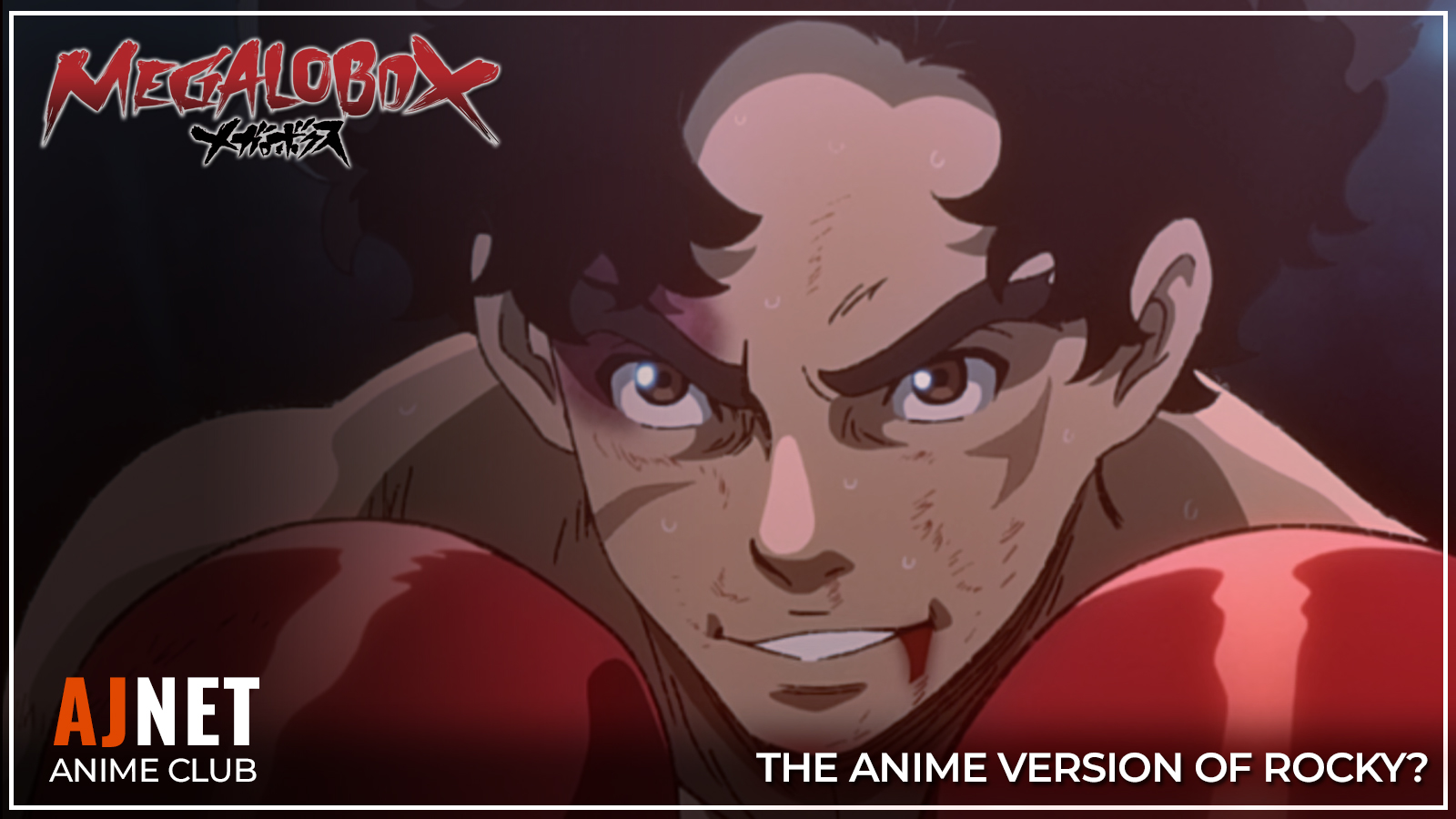
As a fan of Baki, I’m always in the market for a good fighting anime.
It doesn’t necessarily have to feature superhuman lunatics ripping each other’s faces off, surviving falls from skyscrapers, or imagining that their arms have turned into giant dinosaurs. I love the ridiculousness of Baki, but I can also enjoy a more grounded combat sports series. Give me two well-developed fighters, a believable reason for them to beat the shit out of each other, and some decent animation, and I’m probably going to have a good time.
That’s how I came across Megalobox.
Megalobox takes place in a near-future world where traditional boxing has evolved into a sport in which fighters wear mechanical frames called Gear to strengthen their punches and movements. The series follows an undocumented underground boxer known as Junk Dog, who makes a living fighting fixed matches under the direction of his trainer, Nanbu. After a humiliating encounter with the undefeated champion Yuri, Junk Dog takes the name Joe and sets his sights on Megalonia, the biggest Megaloboxing tournament in the world. Since he doesn’t have a legitimate identity or access to quality equipment, Joe begins competing without Gear and earns the nickname Gearless Joe. Across its two seasons, the series follows his rise from an unknown underground fighter to a champion, followed by the much harder process of living with what came afterward.
The first season focuses on Joe, Nanbu, and a mechanically gifted street kid named Sachio working together to get Joe into Megalonia. Nanbu secures Joe a fake identity and begins training him properly, although their involvement with the mob makes escaping the underground fighting circuit considerably more complicated. Joe starts working his way through the Megaloboxing rankings without using Gear, attracting attention because he’s essentially entering mechanically enhanced boxing matches with nothing but gloves and a complete lack of self-preservation. His success earns him a place in Megalonia, where he fights increasingly dangerous opponents while moving closer to a rematch with Yuri. The season culminates with Joe and Yuri stripping away everything that separates them and fighting each other on equal terms.
Megalobox was created as a spiritual successor to the classic 1968 boxing manga Ashita no Joe. I’m sure there are plenty of references and parallels between the two that went completely over my head because I’ve never actually read Ashita no Joe. Maybe one day I’ll get around to it, but my manga backlog already looks like the national debt, so I’m not making any promises.
As a Philadelphian, the easiest way for me to explain Megalobox is by comparing it to Rocky.
When you strip away the mechanical Gear and futuristic setting, Gearless Joe’s story has a lot in common with the Italian Stallion’s. Both men started out fighting in low-level matches, although Joe was intentionally throwing his. Both worked for shady criminal figures, came from poor backgrounds, and were given opportunities to prove themselves against champions who initially seemed completely out of their league. Joe and Rocky were naturally talented fighters who had spent most of their lives wasting that talent because they lacked the opportunity and direction to do anything meaningful with it.
Nanbu also fills a role similar to Mickey. He’s an old, hard-drinking trainer who gives Joe plenty of shit while trying to turn him into a legitimate fighter. His methods aren’t always ethical, and his motives are questionable at the beginning, but he genuinely comes to believe in Joe. Their relationship becomes one of the emotional foundations of the series, especially once Nanbu begins risking his own safety to help Joe escape the fixed matches and criminal arrangements that have controlled both of their lives.
Even Yuri invokes Apollo Creed.
When Yuri and Joe first meet, Yuri carries himself with an understandable air of superiority. He’s the undefeated champion backed by a major corporation, while Joe is some stray dog riding around on a motorcycle and fighting in a dump. Yuri beats the hell out of him during their first unofficial match and essentially tells him to earn the right to challenge him properly.
I expected Yuri to turn into an underhanded piece of shit once Joe started climbing the rankings. It would have been easy to have him become insecure, arrange for Joe to be sabotaged, or start cheating because he was afraid of losing his position. Instead, Yuri gradually develops genuine respect for Joe and begins looking forward to their match just as much as Joe does.
Calling Yuri the antagonist doesn’t even feel right because he isn’t a bad guy. He’s simply the final opponent standing between Joe and his goal. By the time they fight, there isn’t any real hatred between them. They’re two warriors fighting for pride, respect, honor, and glory.
Yuri takes this respect further by having his integrated Gear surgically removed before the match. He could have entered the ring with every advantage available to him, but defeating Gearless Joe while wearing the most advanced Gear in the sport wouldn’t have proven anything. Yuri wanted to fight Joe as an equal, even though removing the equipment grafted to his body put him through an enormous amount of pain.
Apollo Creed came to respect Rocky for refusing to stay down, and Yuri respected Joe for refusing to know his place.
Between the name Yuri and the white hair, I’m also assuming the guy is Russian. I don’t remember the series ever confirming that, but he definitely fits the bill of being Russian, I guess you can consider that one more connection between the two stories.
The fights throughout the first season were pretty damn good. They were well animated when the series came out in 2018, and they still hold up. The movements have weight, the punches look painful, and the fighters don’t spend half an episode standing across the ring explaining their techniques to each other.
Most importantly, the fights last exactly as long as they need to.
I hate when anime drags a single battle across multiple episodes for no reason. This isn’t as common as it used to be, but there are still series where a character throws a punch, we get three flashbacks, two internal monologues, and ten minutes of spectators explaining what the punch means before it finally connects. Megalobox respects the viewer’s time. The major fights are given enough room to feel important, but they don’t overstay their welcome.
The first season also had a great soundtrack. A lot of the music carries an underground hip-hop sound that fits Joe, the slums, and the illegal fighting circuit perfectly. It gives the series its own identity and keeps it from feeling like a generic sports anime with science-fiction equipment pasted over it.
I think Sachio might even be the one rapping during parts of the soundtrack.
There’s a scene where he’s walking around talking out loud to himself, then suddenly starts rapping over the episode. Maybe the music was supposed to represent what was happening inside his head. Maybe Sachio was secretly dropping bars whenever the other characters weren’t around. Either way, it was dope.
The second season, NOMAD: Megalobox 2, took the story in a noticeably different direction.
Several years after winning Megalonia, Joe has left his friends behind and returned to underground fighting under the name Nomad. He’s addicted to painkillers, haunted by visions of Nanbu, and deliberately keeping himself disconnected from anyone who might care about him. Joe eventually meets Chief, an immigrant boxer who throws matches to earn money for a community trying to purchase the land they live on. Chief helps Joe begin confronting his addiction and guilt, while Joe helps him compete in a local Megaloboxing tournament. Their friendship gives Joe a reason to stop running from his past and return home.
When Joe finally returns, he discovers that Sachio and the other kids blame him for abandoning Nanbu during the final stage of his illness. Sachio has also become a Megaloboxer, partly because he wants to prove that he never needed Joe. Meanwhile, a former police officer named Mac has returned from paralysis through experimental technology and become one of the biggest names in the sport, although the implant allowing him to fight is affecting his behavior and memory. Joe gradually repairs his relationships with the people he left behind while preparing to face Mac. During that fight, Joe wears Chief’s Gear, carrying a piece of the man who helped him find his way home. The season ends with Joe finally accepting Nanbu’s death, reconciling with his family, and walking away from boxing on his own terms.
From what I’ve read, a lot of people didn’t like the second season. I don’t agree with them, but I can understand why it didn’t work for everyone.
The first season was a straightforward underdog story. Joe started at the bottom, fought his way through the rankings, and earned a shot at the champion. There were complications along the way, but the season always had a clear destination. The audience knew Joe was heading toward Yuri, and each fight brought him one step closer.
Season two was slower, darker, and far more interested in Joe’s emotional condition than his position in the rankings. The goal was no longer becoming champion. Joe had already done that. His new struggle involved making peace with Nanbu’s death and repairing the damage he caused when he abandoned Sachio and the other kids.
In a way, it felt like a darker version of Rocky III. The hero has already reached the top, lost the older trainer who helped him get there, and now has to rebuild himself. The difference is that Joe doesn’t have an Apollo Creed waiting to drag him back into shape on a sunny California beach. He has drug addiction, hallucinations, a group of angry former friends, and a dead immigrant boxer’s Gear.
I initially expected Chief to become Joe’s new protégé. The setup seemed like it was heading in the same direction as Rocky V or Creed, with the former champion training a hungry new fighter who would eventually compete on the world stage. Chief wins his local tournament, Joe learns how to care about somebody again, and the story appears ready to follow both of them into the major leagues.
Thankfully, the series didn’t take that generic route.
Chief dies shortly after winning the tournament, leaving Joe with the lessons he taught him and the Gear he wore. It was a sad way to end the character’s story, especially since Chief had become likable in a relatively small amount of screen time. His death also had a purpose beyond giving Joe something else to feel miserable about. Chief showed Joe that fighting could be about protecting and building something rather than chasing personal glory.
Seeing Joe use Chief’s Gear during his fight with Mac was a great callback. Gearless Joe had once rejected the equipment because he wanted to prove himself using nothing but his own body. Wearing Chief’s Gear showed how much he had changed. He wasn’t fighting to establish himself as the toughest man in the sport anymore, and accepting help no longer felt like weakness.
Season one was still the better of the two. Its momentum was stronger, the fights were more exciting, and Joe’s rise toward Megalonia was easier to get invested in. NOMAD occasionally slowed down too much, and I can understand why people expecting another tournament story might have felt disappointed.
That doesn’t make the second season bad. It had a different story to tell, and I respect the creators for not repeating the first season with a stronger champion and a bigger tournament. The obvious route would have been to keep escalating the fights until Joe was boxing some mechanically enhanced Russian cyborg with nuclear-powered fists.
Instead, they asked what happens to the underdog after he wins.
Joe’s victory didn’t magically fix his life. Fame faded, Nanbu died, and the family they built fell apart. The second season forced him to deal with those consequences and decide whether he was going to keep running or finally return home.
I found the ending satisfying because it brought Joe’s story to a natural conclusion. He didn’t need another championship, a dramatic death in the ring, or one final opponent teased after the credits. Joe repaired his relationships, confronted his guilt, and rediscovered a reason to live outside of proving himself through violence.
Megalobox is a really good series, and I’m surprised it doesn’t receive more attention. It delivers exciting fights without dragging them out, builds sympathetic characters on both sides of the ring, and uses its science-fiction setting without allowing the mechanical gimmicks to overpower the human story. The two seasons may be different in tone, but together they tell a complete story about ambition, loss, and redemption.
Fans of Baki shouldn’t expect anyone to fight an imaginary praying mantis or stop an earthquake with a punch.
They should still give Gearless Joe a shot.
AJ’s rating: 8/10

More from Angry_Jerk


Don't miss any new posts. Join AJnet Magazine's mailing list and receive updates straight to your inbox once a week!