
A student asked me last week why anyone would willingly go to Antarctica.
Not for scientific research or national prestige. He wasn’t asking what motivated polar exploration in the early 20th century. That would have required him to think about something beyond whatever stupid video was playing on his phone beneath the desk.
What he meant was, why would anybody go somewhere cold when they could simply stay home?
This is the level of intellectual curiosity I’m dealing with after nearly twenty years of teaching history. Human beings spent thousands of years exploring unknown lands, crossing oceans, climbing mountains, and surviving places seemingly designed to kill them. Meanwhile, one of my students recently refused to come to school because the temperature dropped below 30 degrees and he didn’t like waiting for the bus.
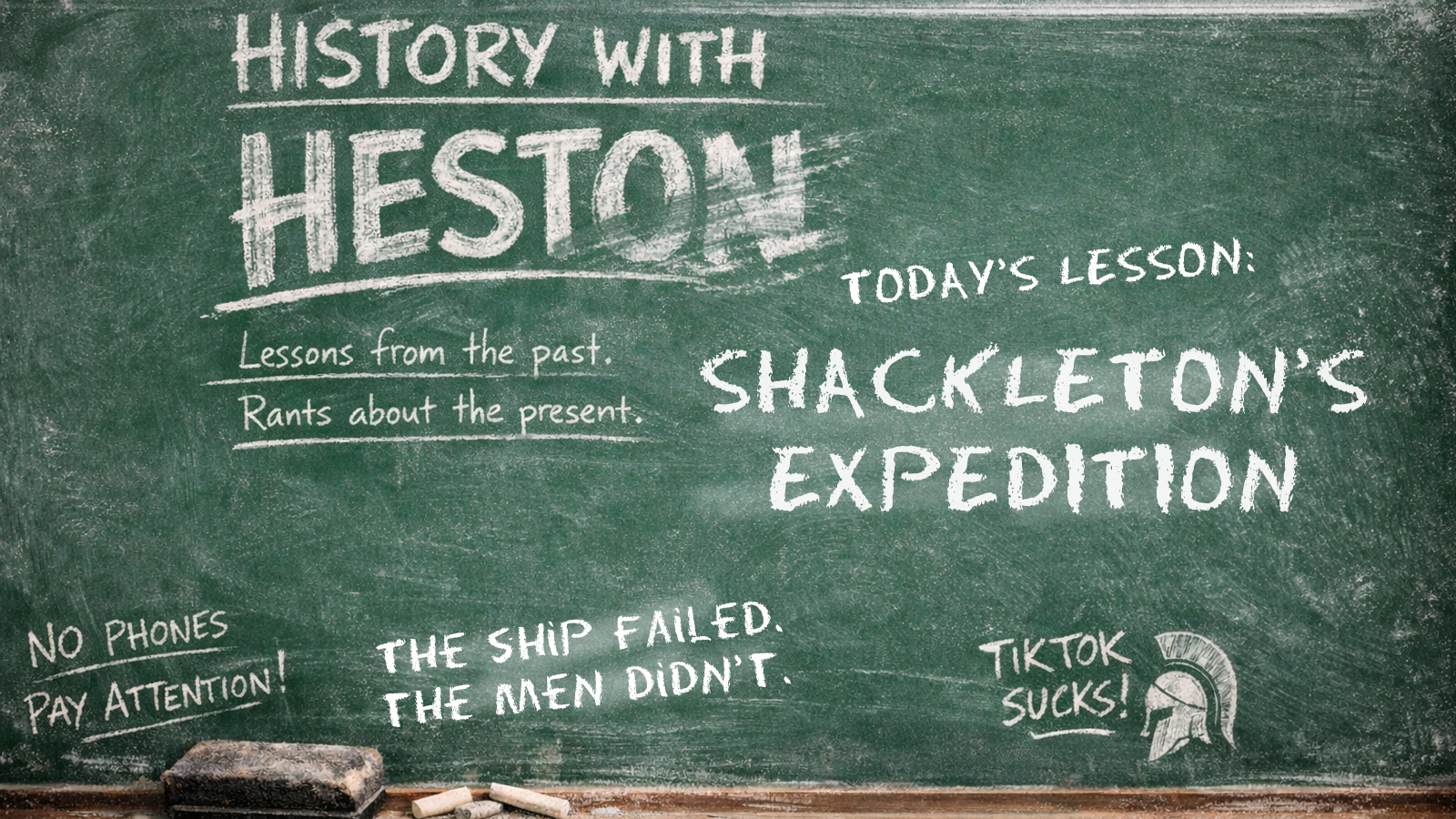
Welcome back to History With Heston. Today we’re talking about Ernest Shackleton and the Imperial Trans-Antarctic Expedition, better known as the Endurance expedition.
It was one of the most spectacular failures in the history of exploration.
Shackleton did not accomplish his objective. He did not cross Antarctica. His ship was crushed by ice and sank before he even reached the continent. His men spent more than a year stranded in one of the most hostile environments on Earth, slowly drifting through the Weddell Sea with no way to contact the outside world.
Yet all 28 men aboard the Endurance survived.
That is why we still talk about Shackleton. Plenty of explorers have successfully completed difficult expeditions. Shackleton became a legend because when everything went completely to shit, he managed to bring every one of his men home alive.
By 1914, the race to reach the South Pole was already over. Norwegian explorer Roald Amundsen had arrived there in December 1911, beating Robert Falcon Scott’s British expedition by more than a month. Scott and four companions died during the return journey, turning the whole thing into a national tragedy.
Shackleton wanted a new challenge. His plan was to become the first man to cross the entire Antarctic continent, traveling from the Weddell Sea to the Ross Sea by way of the South Pole. It would have been a journey of roughly 1,800 miles through a frozen wilderness where temperatures could fall far below zero and a minor injury could become a death sentence.
This was before satellite navigation, emergency helicopters, heated clothing, or some asshole on YouTube reviewing the best portable battery pack for polar expeditions. Once these men sailed south, they were on their own.
The Endurance left South Georgia on December 5, 1914, carrying Shackleton, 27 other men, dozens of sled dogs, and a cat named Mrs. Chippy. The ship had been constructed for polar waters, with a heavily reinforced wooden hull designed to withstand contact with ice.
Unfortunately, the Weddell Sea was not interested in the ship’s design specifications.
In January 1915, the Endurance became trapped in pack ice before reaching its intended landing site. The crew tried to free the vessel, but the ice had closed around it. There was no open water ahead and no open water behind them. The ship was stuck.
Imagine being trapped aboard a wooden ship in the middle of the Antarctic ice with no radio capable of reaching civilization and no way of knowing when the ice might release you. Most people today start panicking when their flight is delayed by two hours. These men faced the possibility of remaining stranded for an entire winter, assuming the pressure from the ice didn’t crush the ship first.
Shackleton understood immediately that panic would kill them faster than the cold. He established routines, assigned duties, encouraged games, and kept the crew occupied. The men exercised the dogs, maintained equipment, played football on the ice, and staged performances aboard the ship.
This wasn’t because Shackleton thought everyone needed a fun little team-building retreat. He understood that despair was dangerous. Once men stopped believing survival was possible, discipline would collapse, arguments would spread, and people would begin making reckless decisions.
Leadership is not standing in front of a camera and vomiting motivational slogans while someone else handles the real work. Leadership is maintaining order when the ship is trapped, the temperature is dropping, and every man under your command knows he might never see home again.
The Endurance drifted with the ice for months. When the Antarctic winter ended, the pressure surrounding the vessel grew worse. Massive sheets of ice pushed against the hull until the wood began twisting and breaking.
In October 1915, Shackleton finally ordered the crew to abandon ship.
The men carried food, equipment, tents, and the ship’s three lifeboats onto the ice. Several weeks later, they watched as the Endurance disappeared beneath the surface of the Weddell Sea.
Their transportation was gone. Their original mission was finished. They had no permanent shelter, no reliable means of communication, and no rescue party looking for them because nobody knew where they were.
The expedition had now become a survival operation.
Shackleton initially planned to drag the lifeboats across the ice toward open water, but the surface was too broken and uneven. After seven days of exhausting labor, the party had traveled only about seven and a half miles. Shackleton abandoned the march and established another camp on the drifting ice.
Knowing when to abandon a bad plan is part of being a competent leader. This is something modern institutions struggle to understand. Schools will continue using a failed program for five years because some administrator paid a consulting company to design it. Shackleton watched his men nearly kill themselves dragging boats across useless terrain and decided to stop.
There was no ego involved. The objective was survival.
For months, the men lived on the ice as it drifted north. They slept in tents, ate dwindling supplies, hunted seals and penguins, and waited for conditions to change. Personal possessions were discarded because anything unnecessary became extra weight. Eventually, even most of the dogs were killed because the party could no longer afford to feed them.
This is the ugly part of survival that movies like to skip over. There was no inspirational soundtrack playing while everyone learned the value of friendship. These men were cold, filthy, hungry, exhausted, and slowly running out of options.
In April 1916, the ice beneath their camp finally began to break apart. Shackleton ordered the men into the lifeboats, and they spent nearly a week battling freezing water, violent seas, exhaustion, seasickness, and dehydration before reaching Elephant Island.
It was the first solid ground they had stood on in 497 days.
That sounds like salvation until you understand that Elephant Island was an uninhabited chunk of rock far outside normal shipping routes. Nobody knew they were there. Waiting for a passing vessel would have meant starving to death while staring at the ocean.
Shackleton decided that he and five men would sail one of the lifeboats, the James Caird, more than 800 miles across the Southern Ocean to South Georgia.
Let me explain something to you. The James Caird was only 22 feet long. Shackleton and his men were preparing to cross one of the roughest bodies of water on the planet in a boat roughly the size of something your uncle takes onto a lake to catch bass.
They modified it as best they could, adding a makeshift deck and reinforcing the hull. Frank Worsley, captain of the Endurance, would have to navigate using a sextant while being thrown around by enormous waves beneath a sky that was usually covered in clouds.
One serious navigational error would send them into the open Atlantic, where they would vanish without a trace.
They set out on April 24, 1916.
For more than two weeks, the six men fought through freezing spray, high winds, and massive waves. Their clothing remained soaked. Ice accumulated on the boat and had to be chipped away to keep it from becoming top-heavy. They could barely sleep, and the cramped conditions made movement almost impossible.
My students complain that the seats on our school buses are uncomfortable. Shackleton’s men crossed hundreds of miles of violent ocean packed together in a freezing wooden lifeboat while trying not to drown.
Worsley’s navigation was almost impossibly accurate. Despite having only occasional glimpses of the sun, he guided the James Caird to South Georgia. Missing the island by even a small distance would probably have killed them all.
Reaching South Georgia still did not solve the problem. They landed on the uninhabited side of the island, separated from the whaling stations by mountains, glaciers, and terrain that had never been properly mapped.
Shackleton, Worsley, and Tom Crean crossed the island on foot.
They marched for approximately 36 hours without proper mountaineering equipment. At one point, faced with darkness and no safe route downward, they slid down an icy slope because remaining where they were would likely mean freezing to death.
This is what you people don’t understand about historical endurance. These men did not keep going because they were comfortable, optimistic, or certain they would succeed. They kept going because stopping meant death.
The three men eventually reached the whaling station at Stromness. They were so filthy, weather-beaten, and unrecognizable that the station workers initially struggled to understand who they were or where they had come from.
Shackleton was safe, but 22 men remained trapped on Elephant Island.
He immediately began organizing a rescue.
Ice blocked the first attempts. One vessel ran low on fuel and had to turn back. Another came within roughly 100 miles of Elephant Island before the pack forced it away. Shackleton kept trying, because unlike the useless administrators running modern institutions, he understood that responsibility does not disappear when circumstances become inconvenient.
On August 30, 1916, the Chilean vessel Yelcho finally reached Elephant Island.
Every man was still alive.
Shackleton had failed to cross Antarctica. The Endurance lay at the bottom of the Weddell Sea, the expedition’s equipment was lost, and nearly two years of planning had produced none of the geographic achievements originally promised.
Yet what followed the failure was more impressive than the expedition’s intended objective.
Shackleton kept 28 men disciplined and functional while their situation deteriorated around them. He adjusted his plans when conditions changed, made ruthless decisions when supplies became scarce, placed himself in the most dangerous rescue party, and refused to abandon the men left behind.
That is leadership.
Meanwhile, today we have people who cannot handle a restaurant getting their order wrong without suffering an emotional breakdown. We have students who shut down when an assignment requires more than one page of reading. We have adults who treat every inconvenience as evidence that the universe has personally targeted them.
Nobody is asking you to cross the Southern Ocean in a lifeboat. Nobody expects you to sleep on Antarctic ice or climb an unmapped glacier after spending more than a year slowly starving.
You could start by developing enough resilience to function when the Wi-Fi goes out.
Shackleton’s expedition is remembered because it demonstrates that failure does not have to become defeat. The original plan collapsed almost immediately. Everything that could go wrong eventually did, but the men survived because they remained disciplined, adapted to reality, and continued working.
The Endurance failed to endure.
Shackleton and his men did not.
A student asked me last week why anyone would willingly go to Antarctica.
Not for scientific research or national prestige. He wasn’t asking what motivated polar exploration in the early 20th century. That would have required him to think about something beyond whatever stupid video was playing on his phone beneath the desk.
What he meant was, why would anybody go somewhere cold when they could simply stay home?
This is the level of intellectual curiosity I’m dealing with after nearly twenty years of teaching history. Human beings spent thousands of years exploring unknown lands, crossing oceans, climbing mountains, and surviving places seemingly designed to kill them. Meanwhile, one of my students recently refused to come to school because the temperature dropped below 30 degrees and he didn’t like waiting for the bus.
Welcome back to History With Heston. Today we’re talking about Ernest Shackleton and the Imperial Trans-Antarctic Expedition, better known as the Endurance expedition.
It was one of the most spectacular failures in the history of exploration.
Shackleton did not accomplish his objective. He did not cross Antarctica. His ship was crushed by ice and sank before he even reached the continent. His men spent more than a year stranded in one of the most hostile environments on Earth, slowly drifting through the Weddell Sea with no way to contact the outside world.
Yet all 28 men aboard the Endurance survived.
That is why we still talk about Shackleton. Plenty of explorers have successfully completed difficult expeditions. Shackleton became a legend because when everything went completely to shit, he managed to bring every one of his men home alive.
By 1914, the race to reach the South Pole was already over. Norwegian explorer Roald Amundsen had arrived there in December 1911, beating Robert Falcon Scott’s British expedition by more than a month. Scott and four companions died during the return journey, turning the whole thing into a national tragedy.
Shackleton wanted a new challenge. His plan was to become the first man to cross the entire Antarctic continent, traveling from the Weddell Sea to the Ross Sea by way of the South Pole. It would have been a journey of roughly 1,800 miles through a frozen wilderness where temperatures could fall far below zero and a minor injury could become a death sentence.
This was before satellite navigation, emergency helicopters, heated clothing, or some asshole on YouTube reviewing the best portable battery pack for polar expeditions. Once these men sailed south, they were on their own.
The Endurance left South Georgia on December 5, 1914, carrying Shackleton, 27 other men, dozens of sled dogs, and a cat named Mrs. Chippy. The ship had been constructed for polar waters, with a heavily reinforced wooden hull designed to withstand contact with ice.
Unfortunately, the Weddell Sea was not interested in the ship’s design specifications.
In January 1915, the Endurance became trapped in pack ice before reaching its intended landing site. The crew tried to free the vessel, but the ice had closed around it. There was no open water ahead and no open water behind them. The ship was stuck.
Imagine being trapped aboard a wooden ship in the middle of the Antarctic ice with no radio capable of reaching civilization and no way of knowing when the ice might release you. Most people today start panicking when their flight is delayed by two hours. These men faced the possibility of remaining stranded for an entire winter, assuming the pressure from the ice didn’t crush the ship first.
Shackleton understood immediately that panic would kill them faster than the cold. He established routines, assigned duties, encouraged games, and kept the crew occupied. The men exercised the dogs, maintained equipment, played football on the ice, and staged performances aboard the ship.
This wasn’t because Shackleton thought everyone needed a fun little team-building retreat. He understood that despair was dangerous. Once men stopped believing survival was possible, discipline would collapse, arguments would spread, and people would begin making reckless decisions.
Leadership is not standing in front of a camera and vomiting motivational slogans while someone else handles the real work. Leadership is maintaining order when the ship is trapped, the temperature is dropping, and every man under your command knows he might never see home again.
The Endurance drifted with the ice for months. When the Antarctic winter ended, the pressure surrounding the vessel grew worse. Massive sheets of ice pushed against the hull until the wood began twisting and breaking.
In October 1915, Shackleton finally ordered the crew to abandon ship.
The men carried food, equipment, tents, and the ship’s three lifeboats onto the ice. Several weeks later, they watched as the Endurance disappeared beneath the surface of the Weddell Sea.
Their transportation was gone. Their original mission was finished. They had no permanent shelter, no reliable means of communication, and no rescue party looking for them because nobody knew where they were.
The expedition had now become a survival operation.
Shackleton initially planned to drag the lifeboats across the ice toward open water, but the surface was too broken and uneven. After seven days of exhausting labor, the party had traveled only about seven and a half miles. Shackleton abandoned the march and established another camp on the drifting ice.
Knowing when to abandon a bad plan is part of being a competent leader. This is something modern institutions struggle to understand. Schools will continue using a failed program for five years because some administrator paid a consulting company to design it. Shackleton watched his men nearly kill themselves dragging boats across useless terrain and decided to stop.
There was no ego involved. The objective was survival.
For months, the men lived on the ice as it drifted north. They slept in tents, ate dwindling supplies, hunted seals and penguins, and waited for conditions to change. Personal possessions were discarded because anything unnecessary became extra weight. Eventually, even most of the dogs were killed because the party could no longer afford to feed them.
This is the ugly part of survival that movies like to skip over. There was no inspirational soundtrack playing while everyone learned the value of friendship. These men were cold, filthy, hungry, exhausted, and slowly running out of options.
In April 1916, the ice beneath their camp finally began to break apart. Shackleton ordered the men into the lifeboats, and they spent nearly a week battling freezing water, violent seas, exhaustion, seasickness, and dehydration before reaching Elephant Island.
It was the first solid ground they had stood on in 497 days.
That sounds like salvation until you understand that Elephant Island was an uninhabited chunk of rock far outside normal shipping routes. Nobody knew they were there. Waiting for a passing vessel would have meant starving to death while staring at the ocean.
Shackleton decided that he and five men would sail one of the lifeboats, the James Caird, more than 800 miles across the Southern Ocean to South Georgia.
Let me explain something to you. The James Caird was only 22 feet long. Shackleton and his men were preparing to cross one of the roughest bodies of water on the planet in a boat roughly the size of something your uncle takes onto a lake to catch bass.
They modified it as best they could, adding a makeshift deck and reinforcing the hull. Frank Worsley, captain of the Endurance, would have to navigate using a sextant while being thrown around by enormous waves beneath a sky that was usually covered in clouds.
One serious navigational error would send them into the open Atlantic, where they would vanish without a trace.
They set out on April 24, 1916.
For more than two weeks, the six men fought through freezing spray, high winds, and massive waves. Their clothing remained soaked. Ice accumulated on the boat and had to be chipped away to keep it from becoming top-heavy. They could barely sleep, and the cramped conditions made movement almost impossible.
My students complain that the seats on our school buses are uncomfortable. Shackleton’s men crossed hundreds of miles of violent ocean packed together in a freezing wooden lifeboat while trying not to drown.
Worsley’s navigation was almost impossibly accurate. Despite having only occasional glimpses of the sun, he guided the James Caird to South Georgia. Missing the island by even a small distance would probably have killed them all.
Reaching South Georgia still did not solve the problem. They landed on the uninhabited side of the island, separated from the whaling stations by mountains, glaciers, and terrain that had never been properly mapped.
Shackleton, Worsley, and Tom Crean crossed the island on foot.
They marched for approximately 36 hours without proper mountaineering equipment. At one point, faced with darkness and no safe route downward, they slid down an icy slope because remaining where they were would likely mean freezing to death.
This is what you people don’t understand about historical endurance. These men did not keep going because they were comfortable, optimistic, or certain they would succeed. They kept going because stopping meant death.
The three men eventually reached the whaling station at Stromness. They were so filthy, weather-beaten, and unrecognizable that the station workers initially struggled to understand who they were or where they had come from.
Shackleton was safe, but 22 men remained trapped on Elephant Island.
He immediately began organizing a rescue.
Ice blocked the first attempts. One vessel ran low on fuel and had to turn back. Another came within roughly 100 miles of Elephant Island before the pack forced it away. Shackleton kept trying, because unlike the useless administrators running modern institutions, he understood that responsibility does not disappear when circumstances become inconvenient.
On August 30, 1916, the Chilean vessel Yelcho finally reached Elephant Island.
Every man was still alive.
Shackleton had failed to cross Antarctica. The Endurance lay at the bottom of the Weddell Sea, the expedition’s equipment was lost, and nearly two years of planning had produced none of the geographic achievements originally promised.
Yet what followed the failure was more impressive than the expedition’s intended objective.
Shackleton kept 28 men disciplined and functional while their situation deteriorated around them. He adjusted his plans when conditions changed, made ruthless decisions when supplies became scarce, placed himself in the most dangerous rescue party, and refused to abandon the men left behind.
That is leadership.
Meanwhile, today we have people who cannot handle a restaurant getting their order wrong without suffering an emotional breakdown. We have students who shut down when an assignment requires more than one page of reading. We have adults who treat every inconvenience as evidence that the universe has personally targeted them.
Nobody is asking you to cross the Southern Ocean in a lifeboat. Nobody expects you to sleep on Antarctic ice or climb an unmapped glacier after spending more than a year slowly starving.
You could start by developing enough resilience to function when the Wi-Fi goes out.
Shackleton’s expedition is remembered because it demonstrates that failure does not have to become defeat. The original plan collapsed almost immediately. Everything that could go wrong eventually did, but the men survived because they remained disciplined, adapted to reality, and continued working.
The Endurance failed to endure.
Shackleton and his men did not.

More from J. R. Heston



Don't miss any new posts. Join AJnet Magazine's mailing list and receive updates straight to your inbox once a week!