
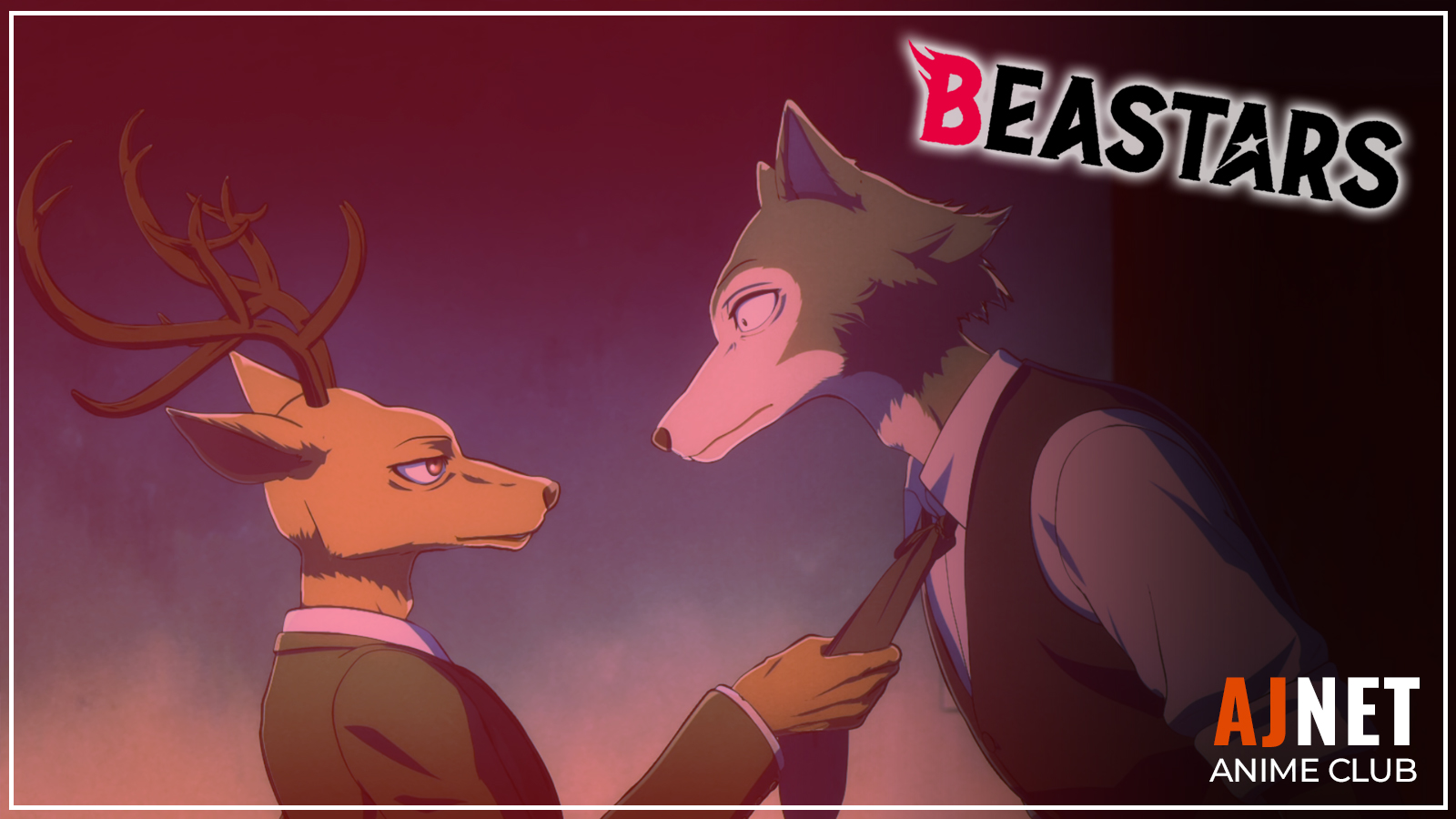
I avoided watching Beastars for years because I thought it was furry anime.
I knew people said it was good, and I’d see it come up whenever someone asked for anime recommendations on Reddit or some other online forum. But every screenshot showed a bunch of anthropomorphic animals walking around in school uniforms, and the fanbase seemed to contain an uncomfortable amount of grown adults who wear animal costumes and use words like “yiff.”
I keep my distance from any grown adult who wears an animal costume and says “yiff.”
What finally convinced me to give Beastars a chance was the amount of praise it received, along with the fact that it was created by Paru Itagaki, daughter of Baki the Grappler creator Keisuke Itagaki. I’m a fan of Baki, so I was curious to see what kind of series would come from the daughter of the man responsible for creating some of the most grotesquely muscular human beings ever drawn.
It turns out all those people recommending Beastars actually knew what they were talking about.
Beastars takes place in a world populated entirely by anthropomorphic animals, where carnivores and herbivores live together under a very fragile peace. The story follows Legoshi, a timid gray wolf attending Cherryton Academy, whose intimidating appearance causes most of the herbivore students to fear him even though he goes out of his way to avoid conflict. After an alpaca student is murdered and eaten by an unknown carnivore, tensions between the two groups begin rising throughout the school. Legoshi also becomes involved with Haru, a dwarf rabbit whose relationship with him forces him to confront the difference between romantic attraction and his natural predatory instincts. Meanwhile, several of Cherryton’s more ambitious students are competing for recognition as the next Beastar, a prestigious figure meant to serve as a leader and symbol of unity for society.
“Beastar” can also be read as “Be A Star.”
I’m not sure if that was intentional or not, but I’m going to pretend that it was.
Being named a Beastar basically turns someone into a major celebrity and public leader, which makes the title sound a lot more important than the glorified popularity contest it sometimes appears to be at the school level. Louis, a red deer and the star actor of Cherryton’s drama club, is one of the leading candidates. He’s intelligent, charismatic, driven, and determined to prove that being an herbivore doesn’t make him weak.
Legoshi works backstage in the same drama club, preferring to remain out of sight. He’s physically enormous compared to most of his classmates, but he’s quiet, awkward, and constantly suppressing the instincts that come with being a wolf. The contrast between how threatening he looks and how uncomfortable he is with frightening anyone makes him a pretty likable protagonist.
The dynamic between Legoshi and Haru is where things start getting weird.
Haru is a tiny white rabbit who has been ostracized by most of the girls at school because she sleeps around. She’s blunt, independent, and tired of being treated like something weak and helpless because of her size. Legoshi first encounters her at night and nearly eats her before regaining control of himself, which leaves him confused about whether he wants to protect her, date her, or consume her like a snack.
That sounds like the setup for some bizarre furry porn, and at times it gets dangerously close.
At three episodes in, a rabbit is about to go down on a wolf.
What the fuck am I watching?
The relationship becomes easier to understand as the series goes on, and the sexual material usually has some relevance to the characters rather than existing purely for fan service. Haru uses sex as a way to escape the way other animals infantilize her, since it’s one of the few situations where they treat her as an equal. Legoshi’s attraction to her is complicated by the fact that she’s also exactly the kind of animal his body tells him to hunt.
It creates a level of tension you wouldn’t get from two regular human characters. A teenage romance already comes with enough confusion without one person having to wonder whether the butterflies in his stomach are love or an overwhelming urge to tear the other person apart and eat her.
I also can’t believe it took me as long as it did to understand why the rabbit is promiscuous.
Of course she is, she’s a rabbit.
That’s one of several little details that made me appreciate how much thought went into the world. When Haru senses danger, her ears instinctively stand up before she fully realizes what’s happening. Rodents are significantly smaller than the other students, with some of them barely reaching another character’s ankle. The school also has different accommodations based on species, while carnivores are served carefully regulated meals to keep their meat cravings under control.
There’s also a chicken student who sells her eggs to the school cafeteria. She takes pride in producing good eggs and gets offended when the cafeteria temporarily stops buying them. It’s such a simple idea, but it’s also exactly the kind of thing that would probably happen in a society of talking animals.
There’s actually a lot of clever stuff you can do with this concept, and Beastars takes advantage of far more of it than I expected.
The divide between carnivores and herbivores also works as a pretty effective form of class warfare. Carnivores are physically stronger and could easily overpower most herbivores, but they’re expected to suppress their nature to participate in civilized society. Herbivores hold much of the social authority while living with the knowledge that some of their classmates could kill them within seconds.
Both groups resent each other for different reasons. Herbivores see carnivores as barely restrained monsters, while carnivores feel like they’re treated as criminals for instincts they didn’t choose to have. The murder at the beginning of the series brings all of that distrust to the surface and makes every interaction between the two groups feel slightly uncomfortable.
The world isn’t presented as some simple racial allegory where carnivores represent one group and herbivores represent another. The power dynamic keeps changing depending on the situation. Legoshi can physically overpower most of the school, but socially he’s expected to shrink himself, remain quiet, and constantly reassure everyone that he isn’t dangerous.
Louis has the opposite problem. He’s admired, influential, and treated as a future leader, but he knows that none of that will stop a large carnivore from physically overpowering him. His obsession with appearing strong makes a lot more sense when you realize how much of his authority depends on everyone agreeing to respect it.
The animation was another surprise.
Beastars uses a hybrid 3D style, and I normally don’t care for 3D anime. Characters frequently move like video game models, and their facial expressions can look stiff. Kengan Ashura is a good example of this. Don’t worry, I’ll eventually do a full review of that series.
The style works much better with animals.
Human faces are familiar enough that bad 3D animation immediately falls into that creepy uncanny valley. Nobody knows exactly how a talking wolf or red deer is supposed to move, so the slight artificial quality isn’t as distracting here. The character movements are expressive, the animal features remain consistent, and the series can do things with size and body language that would probably be harder to pull off with regular animation.
Legoshi moves like someone who’s constantly trying to make himself appear smaller than he really is. Haru’s ears react to her surroundings, Louis carries himself with the calculated confidence of someone performing at all times, and the tails of various characters often reveal emotions they’re trying to hide. Studio Orange (the company that animated the show) clearly understood that animating animal characters meant more than putting fur and snouts on human models.
The Baki connection also makes more sense after you watch the show. Paru Itagaki and her father created very different series, but they both seem fascinated by the relationship between civilized behavior and animal instinct. Baki explores this through giant slabs of muscle beating each other half to death, while Beastars explores it through talking animals trying not to eat their classmates.
At least the Beastars characters are supposed to be animals. Half the cast of Baki looks like someone tried to reconstruct a human being based entirely on a description given by a gorilla. Not that I’m hating on it, it’s one of my favorite anime.
Before we wrap this up though, I need to give you one important piece of advice.
Whatever you do, don’t try searching online to find out whether humans exist in the Beastars world.
I made that mistake because I was curious whether humanity had gone extinct or if the animals were living in a separate society somewhere. Instead of receiving a simple answer, I found pages of discussions and fan fiction exploring how humans would interact with the Beastars characters.
Fanfic writers really are bastards sometimes.
Despite its fanbase and the occasional scene that made me wonder whether I’d somehow switched over to furry porn, Beastars is a really solid series. The characters are interesting, the social conflict is more complicated than I expected, and the world makes good use of its anthropomorphic animal concept rather than treating it like a visual gimmick.
I avoided Beastars because I assumed it was made for furries. Maybe it is, but that doesn’t stop the rest of us from enjoying it too. Don’t let the fanbase put you off like it did me.
Go watch this shit.
AJ’s rating: 8/10

More from Angry_Jerk



Don't miss any new posts. Join AJnet Magazine's mailing list and receive updates straight to your inbox once a week!