
I love it when an anime starts with a simple premise, then completely spirals out of control. You go in thinking you know exactly what you’re getting, and a few episodes later you’re sitting there wondering how things escalated this far without you even noticing.
That’s Hell’s Paradise in a nutshell. It presents itself as a straightforward “criminals sent on a dangerous mission” story, then keeps layering on the insanity and the worldbuilding until you’re fully locked in.
The setup is simple enough. Gabimaru, a legendary shinobi known as “Gabimaru the Hollow,” gets captured and sentenced to death. Except, nobody can actually kill him. After multiple failed execution attempts, he’s offered a deal. Travel to a mysterious island, retrieve the Elixir of Life, and earn a full pardon.
He’s not alone either. A group of other condemned criminals are sent along, each paired with an executioner from a clan known as the Yamada Asaemon whose job is to keep them in line or put them down if necessary. On paper, it sounds like a survival mission with some built-in tension between characters. The second they step onto that island, it becomes very clear that the real problem isn’t each other.
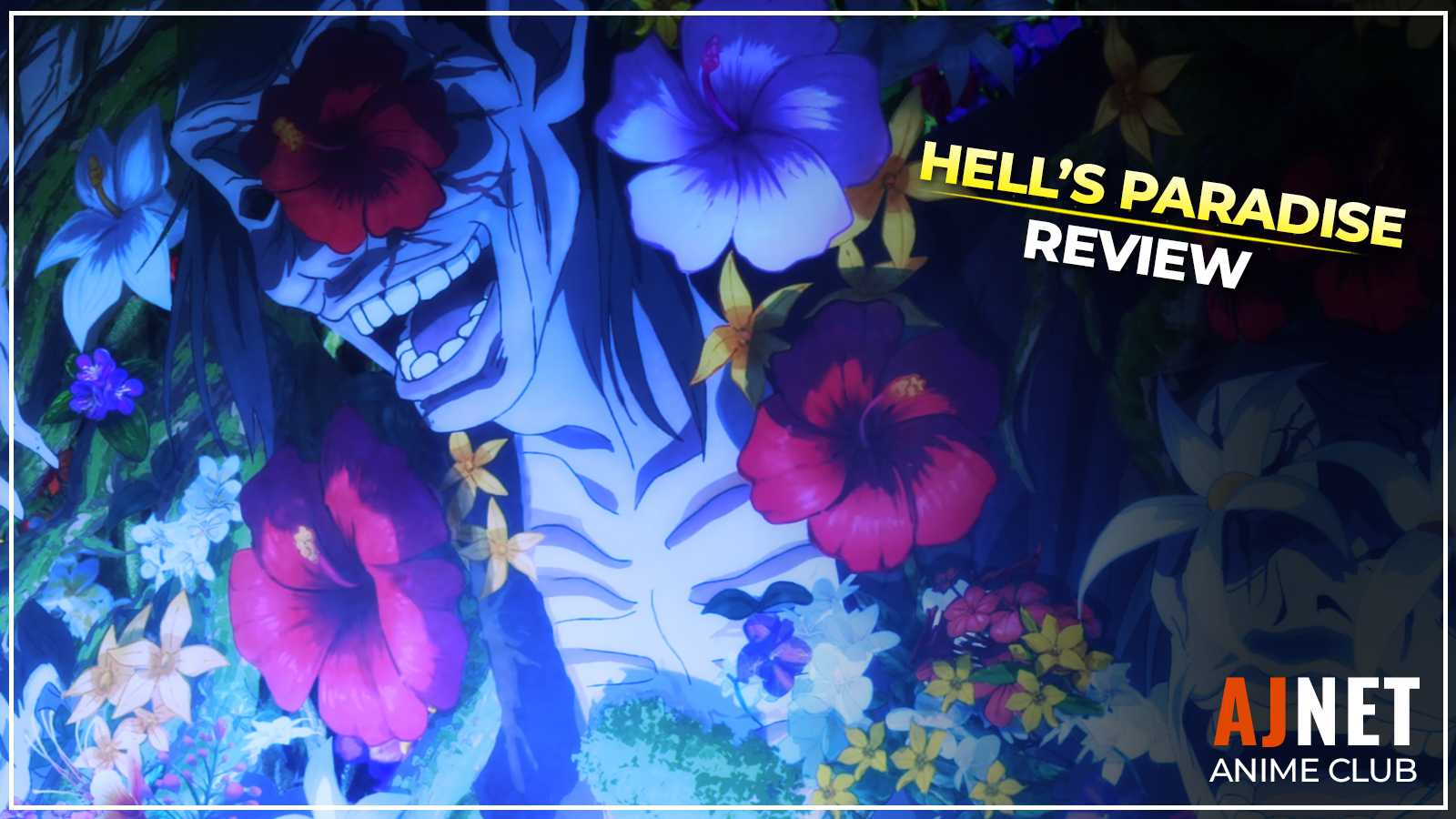
The island is easily the strongest part of the show, and the main reason it stands out so much. Everything about it feels just slightly off. It’s vibrant, colorful, and almost beautiful, but there’s something wrong underneath the surface. The plant life isn’t just there for decoration, it actively interacts with the world in an almost unsettling way. In the very first episode you’ve got a body being overtaken by flowers. As the characters explore the island, it starts to feel like a colorful hellscape instead of a natural setting. The animation does a lot of heavy lifting here. The colors pop without becoming overwhelming, the environments are detailed, and the action sequences actually have weight behind them. Nothing feels stiff or rushed, and the fights are easy to follow without losing any intensity.
The monsters are absolutely crazy. The designs are all over the place in the best way possible. They feel like a combination of Attack on Titan and Gantz, with a dash of Demon Slayer thrown in for style. There’s a mix of body horror, unnatural symmetry, and just enough style to make everything memorable without feeling random. I’m talking things like statue-esque giants with hands for eyes, centipedes with fingers on their mouths, and butterflies with Buddha faces and stingers that make people start growing flowers out of their bodies. Every new encounter feels both dangerous and interesting because you’re never quite sure what the hell they’re dealing with.
Gabimaru himself is probably the weakest part of the show, and even then he’s still solid. On paper, he’s a typical emotionless assassin who slowly rediscovers his humanity, which is a trope that’s been done to death (pun not intended). The difference here is that the story around him does enough to keep that from dragging everything down. His dynamic with Sagiri gives him something to bounce off of, and their interactions help ground the story when everything else is getting absolutely crazy. His development works fine, it’s just not nearly as interesting as everything happening around him. Gabimaru isn’t a bad character or anything, he’s just a little generic, and I think he’s more or less carried by the story and supporting characters.
Those supporting characters are awesome. In particular, Shion is one of my favorites. The blind samurai trope has been done a lot, but when it works, it really works, and this is one of those cases. His fight with Zhu Jin is one of the standout moments in the series because of how simple and brutal the solution is. He realizes pretty quickly that, because of weaknesses involving tao, he doesn’t have a clean way to win. Instead of getting some inexplicable last-second power-up or being saved by a lucky break, he commits to a strategy that’s as direct as it gets. He keeps attacking, forcing Zhu Jin to burn through his tao just to survive. By the end of it, he’s slashed him over two hundred times. He doesn’t win in the sense that he kills Zhu Jin, but he accomplishes exactly what he set out to do, which was put him down long enough to allow for an escape. It’s efficient and brutal, and it fits the tone of the show perfectly.
The Tenzen are pretty interesting villains. They feel completely untouchable, and every encounter with them has this underlying sense that the main cast is outmatched. They come off as something closer to forces of nature than standard villains. Every interaction with them feels tense, because you never get the sense that the heroes are anywhere close to being on equal footing. The introduction of tao as a power system ties into this nicely. It doesn’t feel like something that was suddenly added to explain how fights work. A lot of the stronger characters were already using it without realizing it, and when it gets explained it simply feels like a natural extension of the world.
There’s also a really interesting thread running through Gabimaru’s story that hasn’t been fully answered yet. The show keeps hinting that something about his memories might not be right, especially when it comes to his wife. There’s just enough doubt there to make you question whether what he remembers is actually real. If that ends up being false, it completely changes how you look at his character and his motivations. Even if it doesn’t go that route, the fact that the show is willing to plant that kind of uncertainty is a good sign for where the story could go. I’m kind of interested to see where this part of the plot will go.
At this point, the story is starting to open up in a big way. More shinobi and Asaemon have arrived on the island, which shifts things from a survival scenario into something closer to a full-scale conflict. Now you’ve got multiple factions operating at the same time, all with different goals, and the Tenzen still sitting above all of it as a constant threat. There’s also the implication that what’s happening on the island might not stay contained there, which raises the stakes beyond just the people currently involved.
Overall, Hell’s Paradise is a solid watch, especially if you’re into darker fantasy with strong visuals and unpredictable fights. It’s not bringing anything special to the table when it comes to its main character, but everything around him more than makes up for that. The setting is memorable, the monster design is consistently interesting, and the story does a good job of escalating without losing control of itself.
AJ’s rating: 8/10

More from Angry_Jerk



Don't miss any new posts. Join AJnet Magazine's mailing list and receive updates straight to your inbox once a week!