
I have a bad habit of watching anime without fully understanding what I’m getting myself into.
Sometimes I skim the series description and miss several important details. Other times, I apparently just make up an entirely different premise in my head based on who the hell knows what. That’s how I ended up watching a series like Gushing Over Magical Girls, and it’s also how I ended up completely misunderstanding Welcome to the NHK before I even started it.
I first found this series many years ago through 4chan. That sentence alone should give you a general idea of the kind of anime we’re dealing with here. I added it to my seemingly endless list of things I planned on watching eventually, then proceeded to ignore it until recently.
For some reason, I assumed Welcome to the NHK was going to be about a NEET joining a secret government agency and uncovering some massive conspiracy. I’m not sure where I got that idea. It didn’t help that the first episode opens with the main character running around like he’s James Bond while dramatic music plays and shadowy figures conspire against him.
That was the show I thought I was getting.
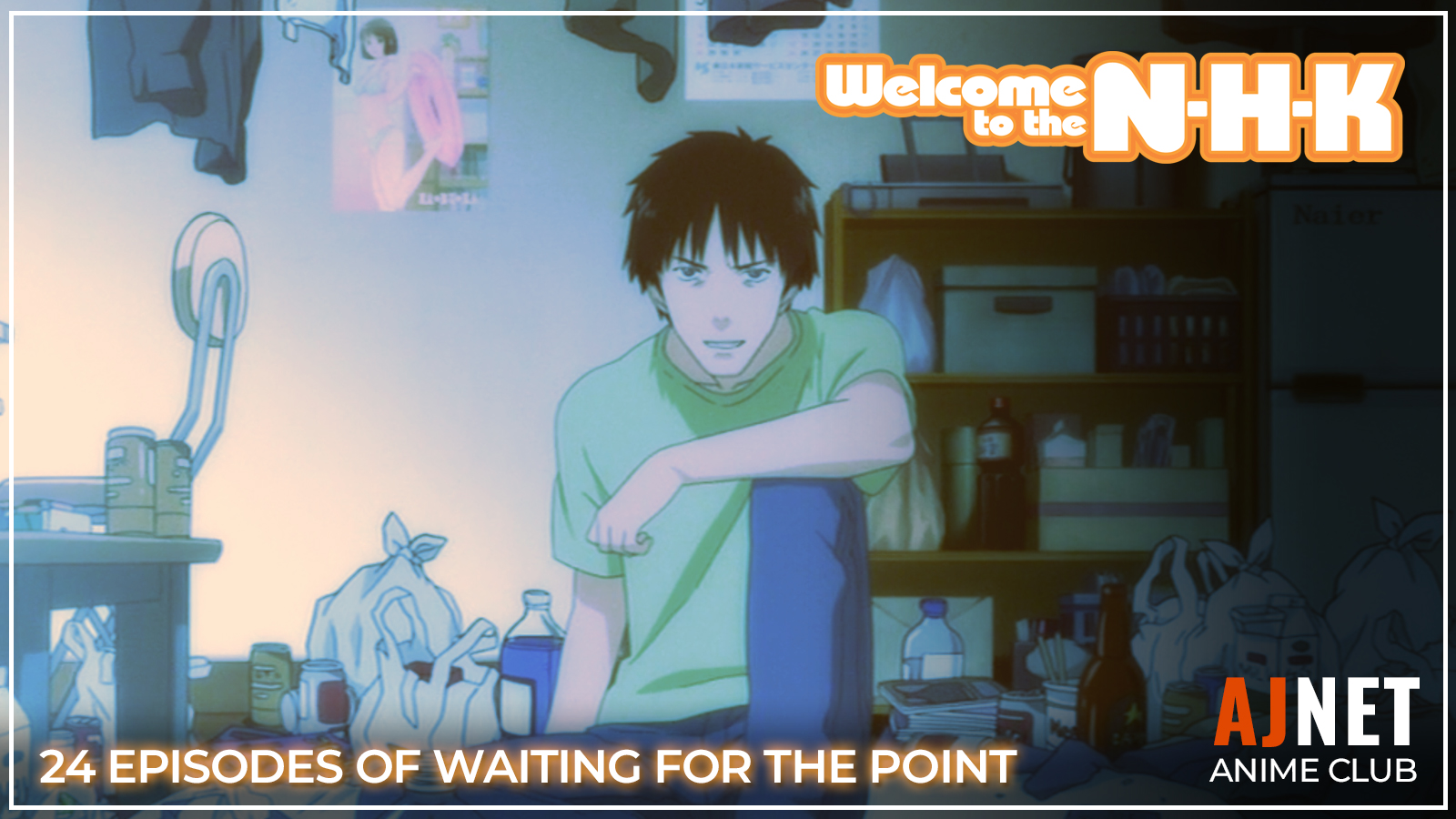
Welcome to the NHK follows Tatsuhiko Satō, a 22-year-old college dropout who has spent several years living as a hikikomori, rarely leaving his apartment and surviving on money from his parents. Satō has convinced himself that a secret organization call the NHK is part of a conspiracy designed to create more socially isolated losers like him. His life begins to change when a mysterious young woman named Misaki Nakahara appears and claims that she can cure him of his shut-in lifestyle. Along the way, Satō reconnects with an old classmate named Yamazaki, gets dragged into developing an adult video game, and repeatedly falls into scams and other terrible situations. The series mixes comedy with some fairly heavy themes involving depression, loneliness, addiction, suicide, and the difficulty of functioning like a normal adult.
So no, Satō does not join a secret government agency.
The conspiracy is mostly something he invented because accepting that his problems are his own fault would require him to actually do something about them. Instead, he blames the NHK, society, his neighbors, and basically anything else but himself. It’s easier than admitting that he’s terrified of interacting with people and has no idea how to fix his life.
Satō also has an extremely active imagination. Throughout the series, he slips into elaborate fantasies where he becomes some confident hero or imagines ordinary situations as giant conspiracies. Some of these scenes reminded me of the stuff Doug Funnie would imagine in Doug, except Doug usually pictured himself as a superhero or secret agent instead of hallucinating household appliances talking to him.
There are also these little gray creatures with letters on their chests who occasionally appear during Satō’s delusions. I think they’re gray, anyway. They might be purple or some kind of off-blue. Whatever color they are, they look like something that escaped from a Dr. Seuss book.
The strange visual sequences were probably my favorite part of the series. They gave Satō’s internal problems a recognizable form and helped make some of the darker material easier to sit through. Without those moments, Welcome to the NHK could have easily become unbearably depressing.
The problem though is that the series never seemed to know exactly where it wanted to go.
At about the halfway point, I still wasn’t sure what the overall point of everything was supposed to be. Satō would make a little progress, fall into another weird situation, embarrass himself, and retreat back into his apartment. Misaki would continue trying to “help” him despite clearly having some serious problems of her own, while Yamazaki alternated between being Satō’s voice of reason and an equally pathetic loser.
The supporting characters are probably the strongest part of the series because none of them are as stable as they initially appear. Everyone is dealing with some combination of loneliness, disappointment, obsession, or fear of the future. Even the characters who look like they have their lives together are usually one bad day away from falling apart.
There are some genuinely good moments here. The story does a solid job showing how people can recognize that they’re ruining their own lives while continuing to make the exact same choices. Satō usually knows when he’s being stupid, but knowing that doesn’t magically give him the ability to stop. That part felt more realistic than the usual anime storyline where one inspirational speech cures several years of severe psychological problems.
At the same time though, the series absolutely drags.
Welcome to the NHK is 24 episodes long, and it doesn’t feel like it has enough material to justify all 24 of them. Several story arcs could have been shortened without losing anything important. By the time I reached the final stretch, I was mostly watching because I had already invested too much time to quit.
The ending didn’t help matters much.
I’m not sure exactly what I expected to happen, but I expected something more substantial than what we got. The series spends 24 episodes building up Satō and Misaki’s problems, then wraps everything up in a way that feels strangely empty. There’s technically some character development, but not enough to make the journey feel worthwhile.
Maybe that was the point. Real people don’t suddenly fix their entire lives because the final episode is coming up. Sometimes they just stumble forward and become slightly less dysfunctional than they were before.
I understand that interpretation, but understanding it doesn’t make the ending more satisfying.
Welcome to the NHK is definitely a product of its time, which probably explains why I originally found it on 4chan. It captures a very specific era of internet culture, when hikikomori, otaku culture, eroge, message boards, and fears about becoming a permanently isolated loser were becoming more visible outside of Japan. Watching it now feels like opening a time capsule from the mid-2000s and finding several old memes, a stack of burned anime DVDs, and a suspiciously sticky keyboard inside.
The series isn’t bad. It has interesting characters, some creative visuals, and a surprisingly honest depiction of people repeatedly sabotaging themselves. The problem is that it takes far too long to reach an ending that offers very little payoff.
I’m glad I finally watched Welcome to the NHK after leaving it on my list for all these years. At least now I know that it isn’t about a NEET becoming Japan’s version of James Bond.
I doubt I’ll ever think about it again after this article goes up, though.
AJ’s rating: 5/10

More from Angry_Jerk



Don't miss any new posts. Join AJnet Magazine's mailing list and receive updates straight to your inbox once a week!
NHK is just like the $40 trillion national-debt that babies and yet to be born citizens are supposed to pay while DemocratRepublican, seniority-system incumbents live like every spy a prince or Biblical King Herods and Pontius Pilates.
Nobody knows what happened to major empires and civilizations in the Late Bronze Age.
Many people think that the DemocratRepublican Idiocracy will disappear in a similar manner.
I read an article about the Sea People in Cracked Magazine online.
Yeah man it’s exactly like that
The Bronze Age was one of the first eras in Taylor Swift’s famous tour,
sort of like the Age of Aquarius by The 5th Dimension.
https://speedgospel.net/1776_Grievance12&SpaceCityJacobsLadder.html