
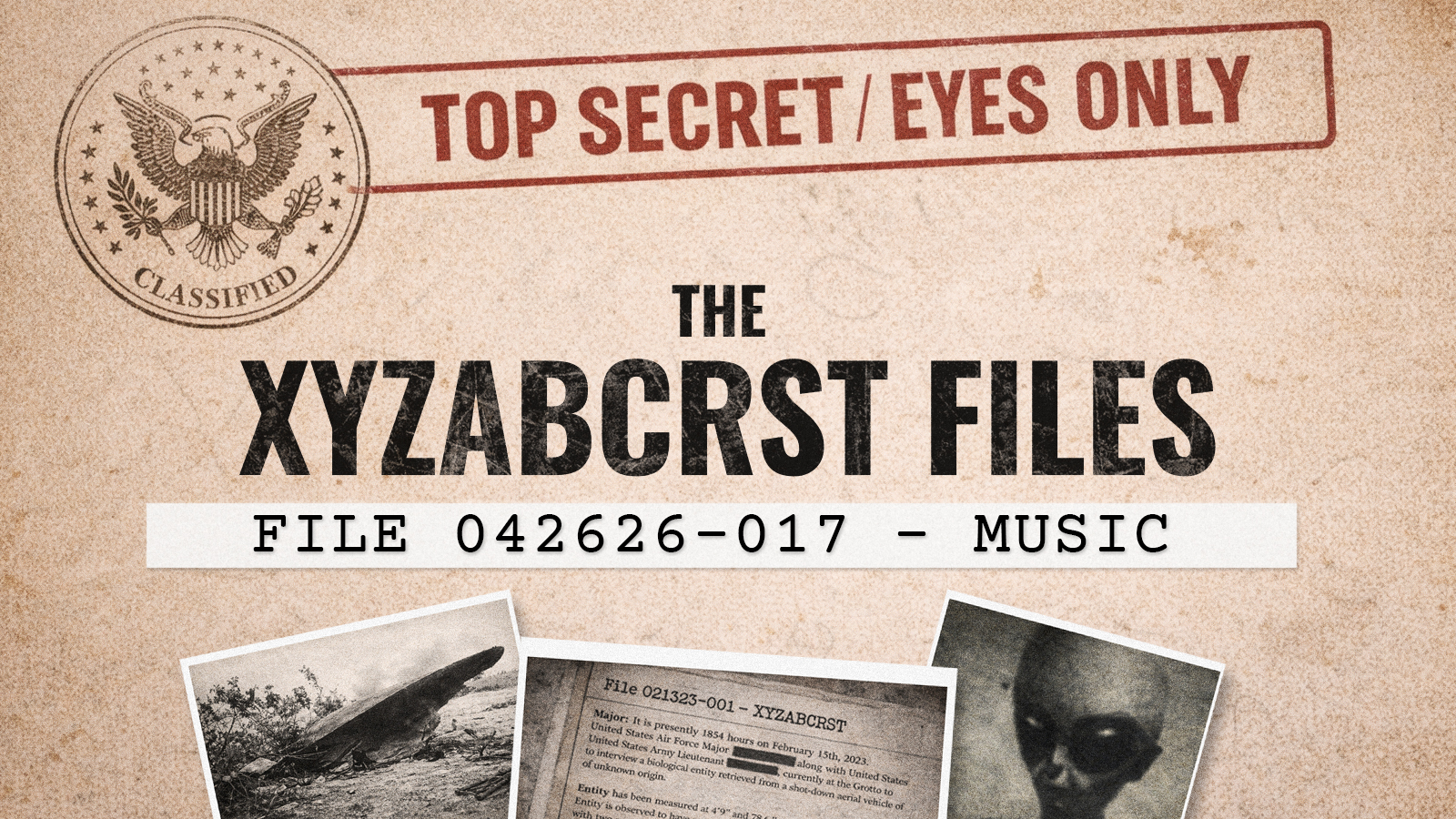
In February of 2023, an unidentified flying object was shot down over Lake Huron and retrieved by the US military. Its sole occupant, an extraterrestrial biological entity named Xyzabcrst, was taken to an undisclosed military facility codenamed “The Grotto” and interviewed by base personnel. The transcripts of these interviews have been provided by an AJnet Organization operative working inside a three letter agency.
The following is a transcript of an interview with Xyzabcrst regarding music.
Major: The time is 1412 hours on April 26th, 2026. I’m Major [REDACTED], here with Lieutenant [REDACTED] and the extraterrestrial biological entity Xyzabcrst. Today we’re going to discuss a human concept known as “music.”
Xyzabcrst: I am familiar with this concept. I have observed it extensively during my monitoring of your planet.
Lieutenant: Good, that saves us some time. What do you think of it?
Xyzabcrst: I find it very unusual.
Major: Unusual how?
Xyzabcrst: Your species organizes sound into structured patterns for no functional purpose. You repeat these patterns, assign them emotional meaning, and distribute them globally. This behavior is not present in any other species I have encountered.
Lieutenant: You’re saying that nobody else in the universe has music?
Xyzabcrst: Correct. Your species is the only one in my known universe that produces “music.”
Major: That’s surprising. Not even advanced civilizations?
Xyzabcrst: Advanced civilizations communicate efficiently. They do not generate patterned sound for entertainment. Sound is typically reserved for signaling, communication, or environmental interaction. Your species is unique in its decision to repurpose it for emotional stimulation.
Lieutenant: So you’re saying we’re the only ones making songs?
Xyzabcrst: Yes. Was that not clear when I stated it the last two times?
Major: Why do you think that is?
Xyzabcrst: It appears to be linked to your species’ emotional volatility. You experience a wide range of internal states and have developed methods to externalize them. Music is one such method. It allows you to transmit emotional states without direct communication.
Lieutenant: Hey, that sounds kind of cool when you put it like that.
Xyzabcrst: It is inefficient.
Major: Inefficient?
Xyzabcrst: Yes. You encode emotional data into abstract sound patterns, which must then be interpreted by another individual. This introduces variability and error. A more advanced system would transmit the emotion directly.
Lieutenant: That sounds creepy.
Xyzabcrst: Your discomfort is noted.
Major: Do you understand different types of music? Genres, for example?
Xyzabcrst: I have categorized several. Your classifications appear arbitrary.
Lieutenant: How so?
Xyzabcrst: You separate music into categories such as “rock,” “classical,” and “hip-hop,” yet all rely on similar structural principles. Rhythm, repetition, and tonal variation are present across all categories. The distinctions are cultural, not functional.
Major: Do you have a preference?
Xyzabcrst: No.
Lieutenant: Come on, you’ve got to like something.
Xyzabcrst: If I am required to select, I find your instrumental compositions more tolerable.
Major: Why is that?
Xyzabcrst: Your vocal music introduces additional inefficiencies. The sounds produced by your vocal cords are often imprecise. Additionally, your species frequently prioritizes emotional expression over clarity, resulting in what you call “lyrics” that are repetitive or nonsensical.
Lieutenant: That’s just part of the style.
Xyzabcrst: It is a flawed style.
Major: What about live performances, like concerts?
Xyzabcrst: I have observed these gatherings. They are concerning.
Lieutenant: Concerning?
Xyzabcrst: Large groups of humans congregate in confined areas, expose themselves to high-decibel sound waves, and engage in erratic physical movement. Some individuals lose control of their motor functions entirely. This is viewed as a positive experience.
Major: That’s called dancing.
Xyzabcrst: It appears to be a loss of coordination.
Lieutenant: He doesn’t like dancing. What a big surprise.
Xyzabcrst: Your species enjoys many things that are not optimal.
Major: Do you think music serves any purpose at all?
Xyzabcrst: It may have secondary effects. I have observed that it can synchronize group behavior, improve morale, and reinforce social bonds. These are useful outcomes, even if the method is inefficient.
Lieutenant: So it’s not completely pointless.
Xyzabcrst: Correct. It is not completely pointless.
Major: If your species doesn’t have music, what do you do for entertainment?
Xyzabcrst: We do not require entertainment in the way your species does.
Lieutenant: That sounds miserable.
Xyzabcrst: It is efficient.
Lieutenant: You and your efficiency…
Major: One last question. If humans are the only species with music, how is it viewed by others?
Xyzabcrst: It is considered a curiosity.
Lieutenant: A curiosity?
Xyzabcrst: Yes. Some species find it interesting. Others find it irritating. A small number have attempted to replicate it, but without your species’ emotional framework, the results fail to produce the same effect.
Major: Have other species actually heard our music?
Xyzabcrst: Of course they have.
Lieutenant: Really?
Xyzabcrst: We talked about this before. (Editor’s note: See File 021323-001 – Xyzabcrst) Do you not remember? Your planet transmits it in all directions. Did you think the rest of the galaxy was somehow unaware of your existence?
Major: Fair point.
Xyzabcrst: For over a century your species has been broadcasting music, advertisements, political speeches, and something called “reality television” into space. Every nearby civilization has heard at least some of it.
Lieutenant: What do they think?
Xyzabcrst: Opinions vary. Most find your music preferable to your politicians.
Major: So we’re the only ones who can really do it right?
Xyzabcrst: “Right” is subjective. You are the only ones who do it at all.
Lieutenant: I’m taking that as a win.
Xyzabcrst: Is that really what your species considers a victory?
Major: Alright, that’s all for today.
Xyzabcrst: Finally.
End recording.

More from Chick Styles



Don't miss any new posts. Join AJnet Magazine's mailing list and receive updates straight to your inbox once a week!