
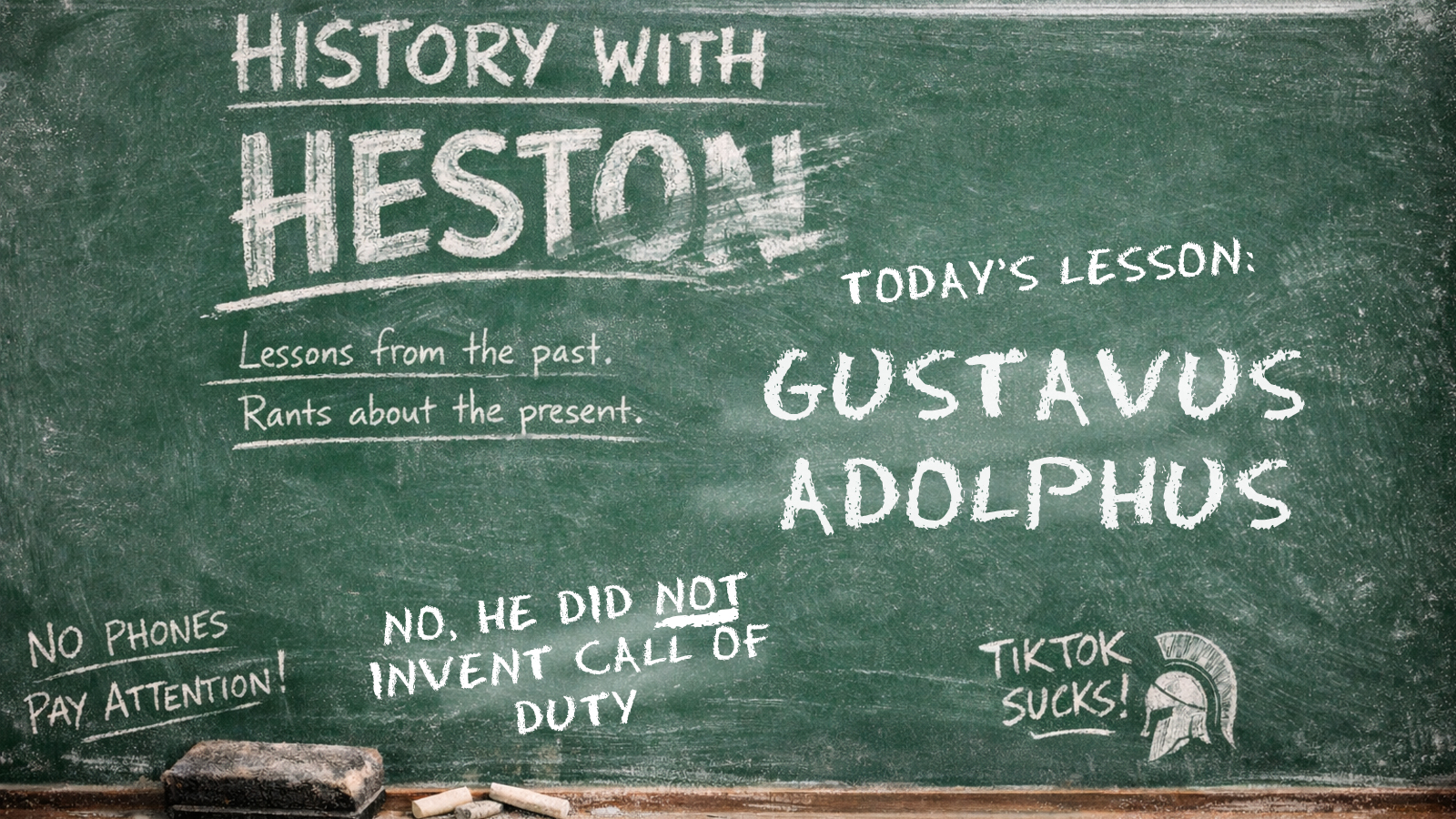
“I have not learned war from books, but from the field.”
That’s Gustavus Adolphus.
If one more student asks me why we have to learn about “some random Swedish guy,” I’m going to start giving them essays that require actual handwriting just to watch them panic. You’d think I asked them to chisel their answers into stone tablets. Half these kids can’t sit still for five minutes without checking their phone, but I’m supposed to convince them that this stuff matters more than TikTok videos.
Yeah, okay. Sure.
Anyway, this “random Swedish guy” took a frozen, relatively minor kingdom and turned it into one of the most feared military powers in Europe.
Gustavus Adolphus was born in 1594 and became King of Sweden at just 16 years old. Sixteen. My students can’t even handle being told to put their AirPods away without acting like they’ve been personally attacked, and this kid is running an entire country surrounded by enemies. Sweden wasn’t exactly sitting pretty either at the time. They were fighting wars with Denmark, Russia, and Poland, all while trying to hold together a kingdom that wasn’t exactly overflowing with resources.
So what does Gustavus do?
He doesn’t sit around whining about how unfair everything is. He gets to work.
First, he reforms the military. And I mean actually reforms it, not just slaps a new name on the same broken system like every school district initiative I’ve seen in the last decade. He restructures his army into smaller, more flexible units, standardizes training, and improves discipline. He makes sure his soldiers actually know what they’re doing, which is apparently a revolutionary concept both in the 1600s and in modern group projects.
Then he takes artillery, which most armies at the time treated like afterthoughts, and turns it into something fast, mobile, and devastating. Instead of dragging around massive cannons that took forever to position, he introduces lighter artillery that can actually keep up with infantry. That means the enemy doesn’t get to just stand there and reset while you fumble around.
It sounds obvious now, but it wasn’t back then.
While everyone else was playing checkers, Gustavus was playing chess. His approach to combined arms shaped modern warfare. He drilled his infantry, cavalry, and artillery to work together as a cohesive unit, which gave him a massive advantage over armies that were still stuck in rigid, outdated tactics.
All of this comes to a head during the Thirty Years’ War, which, if you’re not familiar, was basically Europe deciding to tear itself apart for a few decades over religion, power, and the usual collection of bad decisions. It started as a conflict between Protestant and Catholic states, but like most wars, it quickly turned into a free-for-all where everyone had their own agenda.
Gustavus enters the war in 1630 on the Protestant side, and this is where he really makes his mark.
The Battle of Breitenfeld in 1631 is the moment where Europe collectively realizes, “Oh shit, this guy might be a problem.” Facing the experienced forces of the Holy Roman Empire under Tilly, Gustavus doesn’t just hold his own. He outmaneuvers them completely. His flexible formations and coordinated tactics allow him to absorb pressure and then hit back hard. The Imperial army, which had been dominating up to that point, gets shattered.
And suddenly, Sweden isn’t just some frozen little shithole anymore. They’re a major power.
Gustavus keeps pushing into Germany, racking up victories and building a reputation as one of the most capable commanders of his time. He wasn’t just sitting behind a desk either. He was out there on the battlefield, leading from the front, taking the same risks as his soldiers.
Which, as you might guess, has consequences.
In 1632, at the Battle of Lützen, Gustavus Adolphus leads his forces against the Imperial army under Wallenstein. It’s a brutal, chaotic fight, fought in fog so thick that units could barely see each other. And in the middle of all that confusion, Gustavus rides forward, gets separated from his troops, and is killed in the melee.
Just like that.
Thirty-seven years old. One of the most effective military leaders in Europe, gone in the middle of a battle he was actively leading.
His death was a huge blow, but by that point, he had already changed the game. His reforms didn’t disappear with him. They spread. Other armies took notice. The way he organized troops, the way he used artillery, the way he emphasized coordination and mobility, all of it influenced how wars would be fought going forward.
That’s why he’s often called the “Father of Modern Warfare.” Not because it sounds cool, but because he actually earned it.
And here’s the part that I wish I could drill into my students’ heads without them immediately zoning out:
This was a guy who stepped into a bad situation at a young age and didn’t make excuses. Instead, he made things better through effort, intelligence, and actual leadership. He didn’t wait for perfect conditions, he didn’t complain about what he didn’t have. He took what was in front of him and made it work.
Meanwhile, I’ve got kids telling me they “can’t focus” because the school Wi-Fi is slow.
I’m not saying everyone needs to go out and become a 17th-century warrior king, but the gap between what people are capable of and what they settle for is massive. History is full of examples like Gustavus Adolphus that make that painfully obvious.
The guy helped reshape European warfare before he hit 40.
And I can’t get half a class to bring a pencil.
That’s the lesson.

More from J. R. Heston

Don't miss any new posts. Join AJnet Magazine's mailing list and receive updates straight to your inbox once a week!