
I’ve always had a thing for time travel stories.
The Time Machine is my all-time favorite book, and A Connecticut Yankee in King Arthur’s Court is right behind it. There’s just something fun about dropping a modern person into a different era and watching them completely break everything.
1632 by Eric Flint basically takes that idea and scales it up to an absurd level.
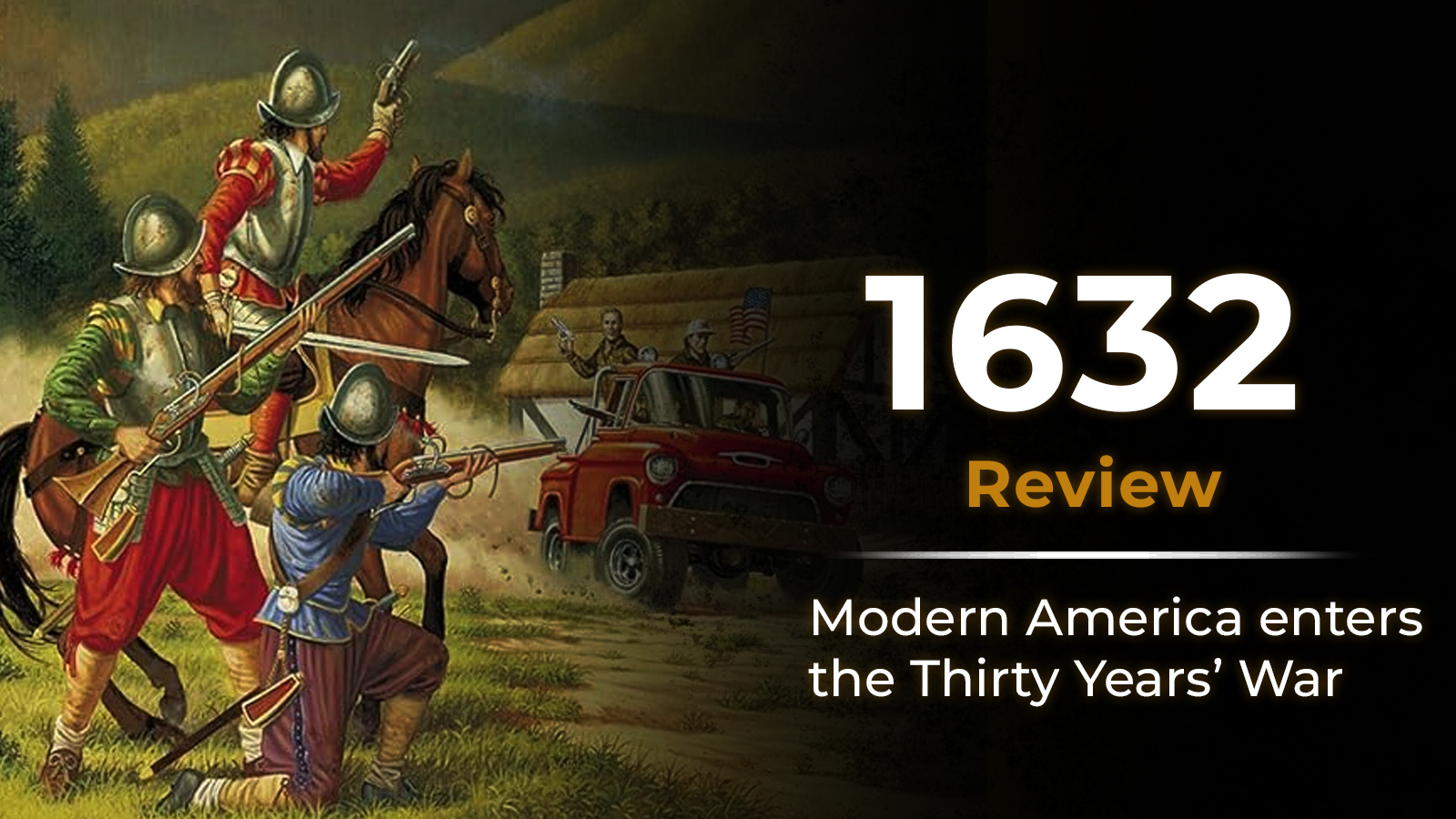
Instead of one guy going back in time, an entire West Virginia town gets ripped out of the year 2000 and dropped into 17th-century Europe, during the Thirty Years’ War. There’s no buildup, it just sort of happens. One minute they’re celebrating a wedding, the next minute they’re smack-dab in the middle of 17th century Germany fighting off mercenaries.
The book doesn’t overcomplicate the premise, and honestly, I think that’s for the best here.
There’s technically an “explanation” in the opening chapter involving some alien race accidentally screwing up the universe, but it’s played almost like a joke and then immediately tossed aside. The townspeople call the event the “Ring of Fire,” and after that, nobody really cares why it happened. Which makes sense, because it’s not like knowing why would change their situation.
The real fun in 1632 isn’t why it happened, though. It’s what happens next.
What happens next is exactly what you’d expect when you bring things like machine guns, industrial tools, and basic 20th-century knowledge to a world that’s still figuring out how to not die from infections.
The battles are, for the most part, complete blowouts.
You’ve got soldiers from the 1600s lining up in formation, charging forward like drunken soccer hooligans, and then getting absolutely shredded by modern firearms. It’s brutal and one-sided as all hell, and there’s a certain dumb satisfaction in watching it happen. I’ve talked about this previously in the AJnet Anime Club, in my review of Gate. I absolutely love vulgar displays of modern power against primitive screwheads.
But the book attempts to remain somewhat grounded in the reality of the situation. Every now and then, the other side gets a few causalities. Not because they’re stronger, but because they either get lucky or they’re smarter in ways the Americans aren’t. There’s a great moment where one of Gustavus Adolphus’s officers points out that the Americans got lucky fighting inexperienced conscripts. Against a real, disciplined commander from that era, things wouldn’t be nearly as easy, even with the advantages provided by modern firearms. Especially if you were to go up against the man who is considered by history to be the father of modern warfare, and one of the greatest military tacticians that the world has ever seen.
I thought that was a nice touch. It keeps things grounded just enough that it doesn’t turn into total nonsense.
I’ll be honest, I have no idea how historically accurate any of this is. That’s Heston’s department. But it feels believable in the ways that matter. The politics, the alliances, the confusion of people trying to understand technology they’ve never seen before, all of it works well enough that you buy into it.
Then you get moments where the book just leans all the way into the insanity, and those are easily the highlights.
There’s a scene near the end where a Spanish force holes up in a castle for the night, thinking they’re safe. The Americans spend the entire night blasting music—like Creedence Clearwater Revival and The Rolling Stones—and setting off fireworks as psychological warfare. Just imagine being a 17th-century soldier hearing that. You don’t know what a speaker is. You don’t know what recorded music is. You don’t know what the hell is happening, only that the sky is exploding and there are thundering voices coming out of nowhere. It would feel like the army of Hell itself had come to lay siege to your fortress.
After keeping them awake and completely rattled all night, the Americans finish their assault by napalming the castle and picking people off as they try to escape.
It’s excessive, brutal, and completely unfair.
And I absolutely fucking loved it.
Not because it’s heroic or noble, but because it fully commits to the idea of technological dominance in a way most stories dance around. This book doesn’t pretend it’s a fair fight. It knows exactly what it is.
I enjoyed this book so much that it actually made me interested in the real history behind it.
I didn’t pick this up to learn about Gustavus Adolphus or the politics of early modern Europe, but by the end of it, I found myself wanting to know more. That’s always a good sign. If a story can push you to go look into the real-world events it’s loosely based on, it’s doing something right. Maybe I’ll ask Heston to write an article about it.
This book feels like something that should have a TV adaptation by now, but it doesn’t. Probably because it’s a niche concept, and you’d need a decent budget to pull it off without it looking terrible. Which is a shame, because this would absolutely work as a Netflix series.
There are a ton of follow-up books too. I haven’t gotten to them yet, but if they’re anywhere near as fun as this one, this could easily turn into a series that I end up tearing through.
At the end of the day, 1632 isn’t trying to be a perfectly accurate historical deep dive, nor does it lean into sci-fi. This is alternate history at its finest.
What happens when modern people get dropped into the past, and actually use everything they have to their advantage?
Turns out, the answer is: liberty, gunfire, and a lot of very confused Europeans.

More from Angry_Jerk


Don't miss any new posts. Join AJnet Magazine's mailing list and receive updates straight to your inbox once a week!