
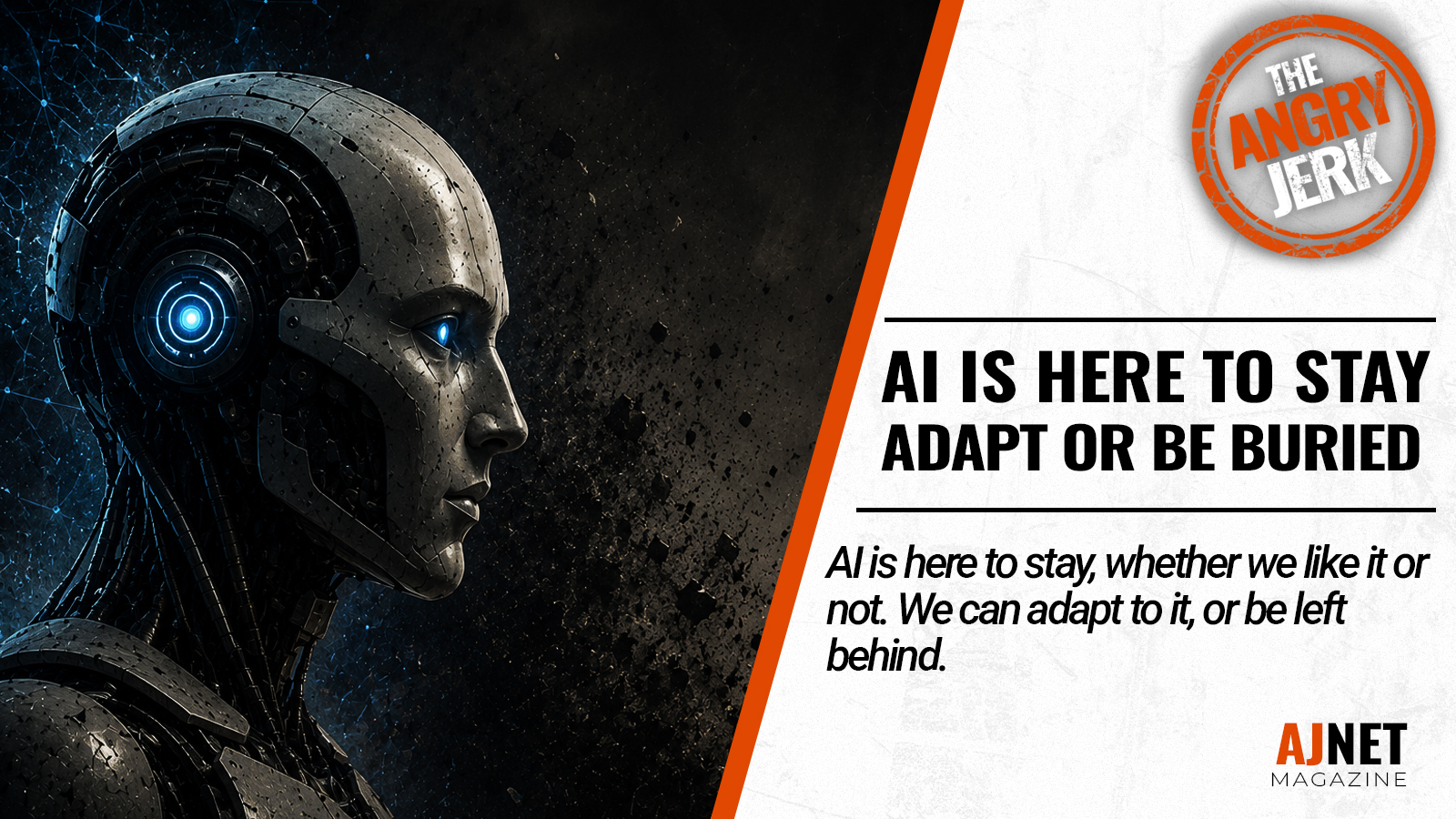
I’ve been seeing a lot of people lose their minds over AI lately.
Everywhere I look, it’s the same handful of talking points. AI is going to steal everyone’s jobs, destroy creativity, and turn the internet into a wasteland of fake content. Some folks are acting like we’re five minutes away from being replaced entirely and left sitting on the curb with cardboard signs while robots clock in for our shifts.
Last year, I wrote an article called “I’m Not Sure How to Feel About AI-Generated Art,” where I tried to look at both sides of the issue. I acknowledged that AI image generation poses a legitimate threat to artists, especially people who rely on commissions to make a living. I also pointed out that it gives creative access to people who can’t draw and don’t have hundreds of dollars to spend every time they need an image.
Since then, we’ve started using AI-generated images on AJnet Magazine, mostly for title cards. Legal has been up my ass about copyright issues, and generating our own images saves us from chasing down licenses or paying royalties every time we publish something. The AJnet Organization isn’t some giant media conglomerate with bottomless pockets. We can’t afford to pay hundreds of dollars per title card or hire a full-time artist to make several of them every week.
We also use AI for proofreading. We don’t blindly accept every suggestion it spits out, and sometimes its suggestions are flat-out stupid, but it’s helped me catch typos and awkward sentences that I missed after staring at the same article for two hours. I still wrote the article and made the argument. AI just helped me clean up some of the mess afterward.
Some people will look down on that or call it cheating, but I don’t see it that way. Complaining about AI isn’t going to stop it from existing, and this isn’t something you can shame out of existence with an angry thread on Reddit or whatever. The technology is here, it’s advancing quickly, and it isn’t going to slow down because people are uncomfortable. We can either figure out how to use it responsibly or sit there and watch it pass us by.
That doesn’t mean the anti-AI crowd is wrong about everything. One of the biggest problems is how these models were trained in the first place. Companies scraped enormous amounts of public data without asking permission, then used that data to build commercial products worth billions of dollars. Meanwhile, the average person can get threatened with a lawsuit for downloading a movie. That’s a massive double standard, and it’s bullshit.
There are also legitimate concerns about fake content, scams, plagiarism, and companies using AI as an excuse to fire people. The rollout has been sloppy and greedy, but those problems don’t erase the technology’s value. AI can speed up research, organize information, improve efficiency, and help small businesses compete with companies that have entire departments doing work one person is trying to handle alone. The answer is to address the problems instead of pretending the technology can be stuffed back into the box.
There’s another potential advantage that gets lost in the argument: AI doesn’t have a personal ego.
Before anyone jumps down my throat, yes, I’m aware that AI models can be biased. I already wrote about the political slant in Google’s AI Overviews, and other models have shown political bias in their responses too. These systems are trained on material produced by human beings, then adjusted by developers who are also human beings. Of course some of our biases are going to end up in the output.
The machine itself, however, doesn’t care whether you like its answer. It doesn’t have a career to protect, a friend to defend, or a personal grudge against the person asking the question. With the right training and rules, an AI system could be useful as a more dispassionate analyst because it has no emotional stake in the outcome. That doesn’t make it automatically correct or unbiased, but there’s potential there.
That lack of emotion can be a weakness in creative work, where personal experience and feeling matter. But it can also be an advantage when you need something to break down a problem without getting defensive or distracted by pride. Anyone who’s ever tried to have a rational argument on social media should understand the appeal.
People have resisted technological change forever. Automation disrupted factories, computers replaced office work, and the internet wiped out businesses that once seemed untouchable. AI is the latest version of that pattern, except now it’s hitting writers and artists who assumed creativity would always belong exclusively to humans. A factory worker being replaced by a machine is treated like an unfortunate side effect of progress, while a writer being replaced by software suddenly becomes an existential crisis for civilization.
I get why creative people are pissed. They’ve spent years learning a craft, only to watch someone type a prompt and produce something passable in thirty seconds. Watching a person waltz in, do a fraction of the work, and collect the reward would irritate anybody. But blindly hating the technology won’t protect those careers. It only leaves the people who refuse to adapt competing against people who didn’t.
AI also lowers the barrier to entry for people who have ideas but lack the skill or money to execute them. Should someone be locked out of creating a visual concept because they can’t draw and can’t afford an artist? There’s room to criticize lazy, low-effort slop without declaring that anyone who uses AI assistance is a fraud.
The current witch-hunt mentality has already gotten ridiculous. People are seeing AI everywhere, even when it isn’t there. If something is well-written, properly structured, and mostly free of errors, someone immediately decides it must have been generated by a machine. Apparently good grammar is suspicious now.Are we all supposed to start writing like 13-year-olds on AOL Instant Messenger to prove we’re human?
shud i start writin evrything lyk dis so u no im not ai??
You could probably train an AI model to write like that too, so I guess we’re screwed either way.
Writers who admit to using AI for proofreading or research get treated like they committed a crime. I’m willing to bet plenty of people and even major publications use it quietly. Why volunteer that information when they know they’ll get nailed to a digital cross for it?
I’ll concede that I’ve made the same mistake. I was reading an article recently and caught myself thinking, “This sounds too polished. Is that an em dash? This has to be AI.” Then I checked the publication date and realized it had been written in the early 2000s. Had I not seen the date, I probably would’ve walked away convinced that a technology that didn’t exist yet had written it.
The job issue is harder to dismiss. AI will eliminate positions, reduce the number of workers some companies need, and hurt people who did nothing wrong. In a perfect world, progress wouldn’t come at the expense of someone’s livelihood. Unfortunately, advancement has always carried a cost, and pretending otherwise doesn’t help the people who are about to get screwed.
If companies are going to make enormous profits from replacing workers with AI, then those companies should be expected to help support the people they displace. I’ve never been a big fan of universal basic income, but this may be one of the rare situations where some version of it makes sense. Tax the companies benefiting most from AI-driven automation and use part of that money for temporary income support, retraining, or other programs for workers whose jobs disappear.
I haven’t worked out the exact numbers, and maybe there are holes in the idea, but the principle seems fair: if a company saves millions by replacing people with machines, some of those savings should help the people who got thrown overboard.
AI isn’t going anywhere. You can complain about it, boycott it, or spend your days accusing every competent writer and artist of being a machine, but none of that changes reality. AI is a tool, and like every other tool, it can be useful, harmful, or completely misused depending on who’s holding it.
Refusing to engage with it isn’t a solution. Learn how it works, understand where it fails, call out the companies abusing it, and use it where it makes sense. The future doesn’t care whether we’re comfortable with it, and I’d rather figure out how to handle the technology than sit around bitching while everyone else moves forward.

More from Angry_Jerk



Don't miss any new posts. Join AJnet Magazine's mailing list and receive updates straight to your inbox once a week!