
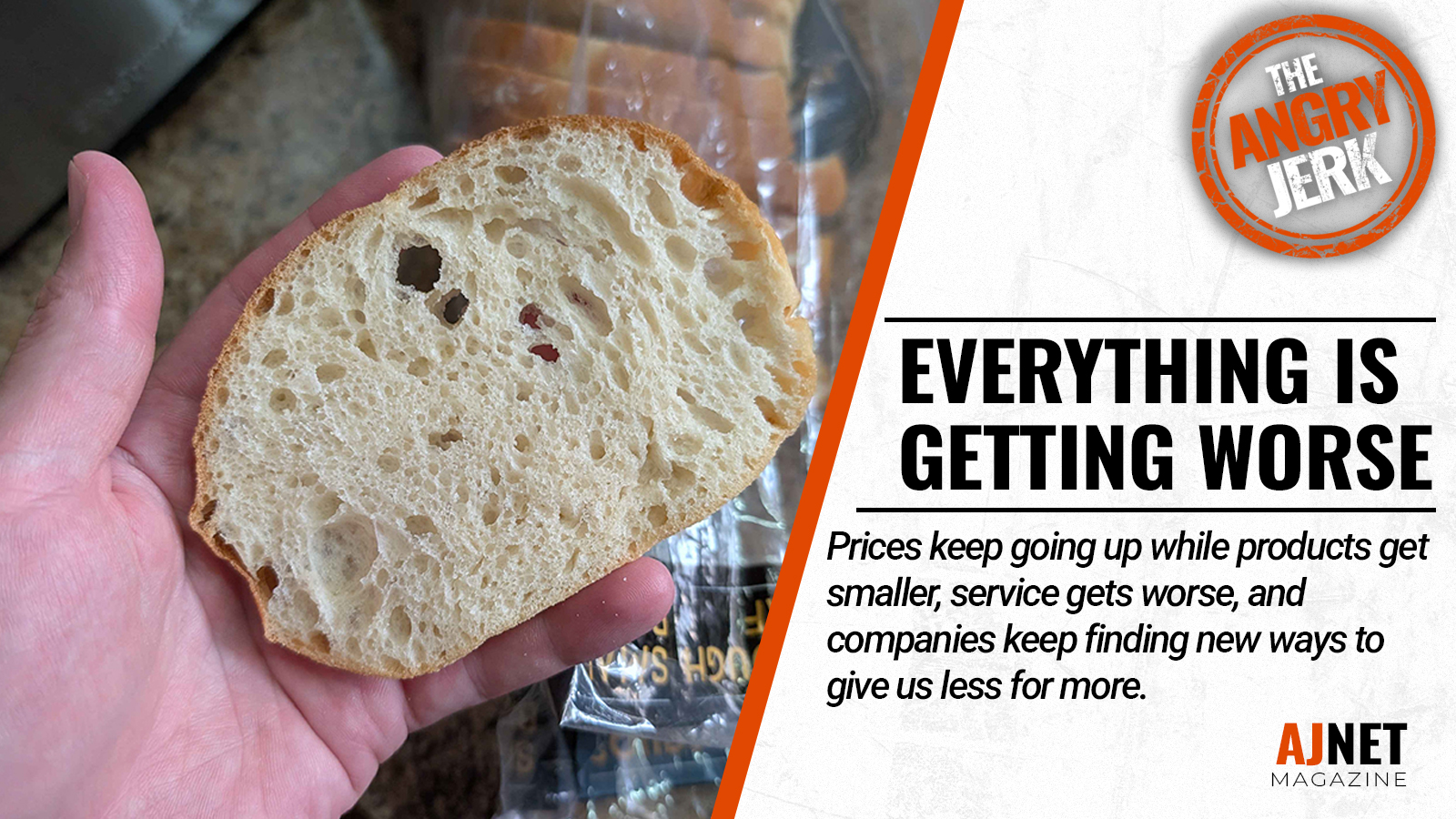
A while back, I went to Aldi to buy my usual Small Batch Sourdough Bread.
Instead of the normal-sized slices I’d been buying for years, I opened the bag and was greeted by these tiny-ass pieces of bread:
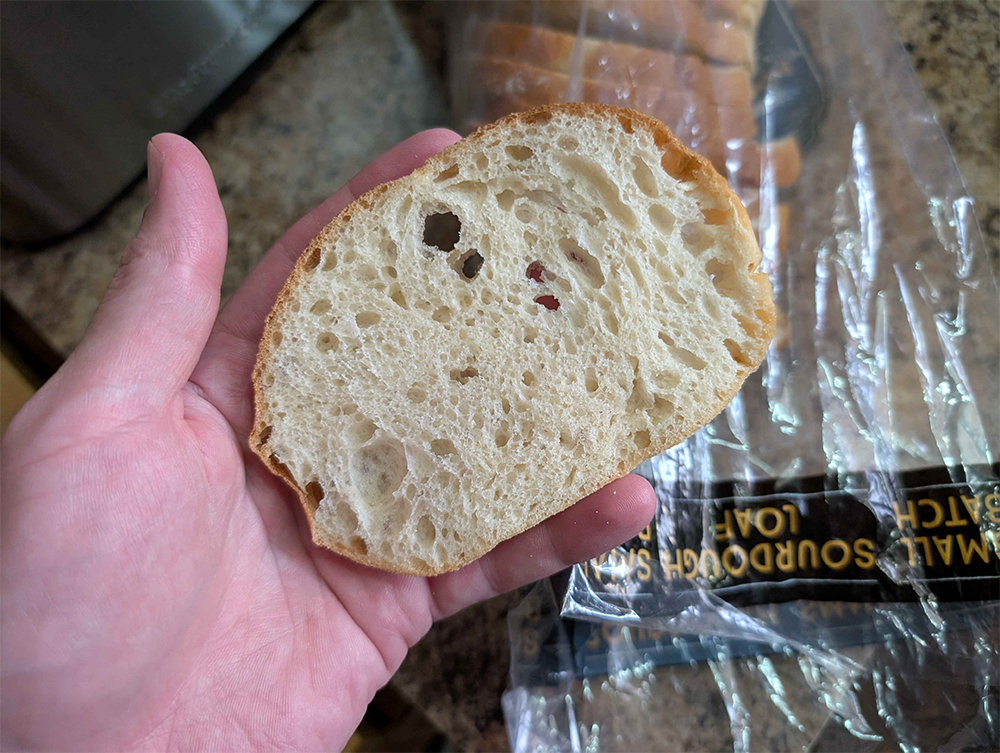
What the fuck am I supposed to do with these? The slices are so small that they get lost inside my toaster. My options are either to burn the shit out of my fingers trying to fish them out, or put them in sideways and accept that part of my toast just isn’t getting toasted. I couldn’t even imagine trying to make a sandwich with these things unless I was packing lunch for a six-year-old.
Making the bread smaller apparently wasn’t enough either. Aldi also changed the ingredients. The old version listed sourdough culture, while the new ingredient list replaced it with things like fermented wheat flour and yeast. I’m not going to pretend to be some artisanal bread expert who spends his weekends lovingly nurturing a 100-year-old starter named Gerald, but if you remove the sourdough culture from your sourdough bread, I feel like we’ve got a pretty fundamental problem here. What the actual fuck makes it sourdough at that point?
The Aldi bread is just one stupid little example of a much bigger problem I’ve been noticing everywhere. Everything costs more than it used to, which we’ve all complained about endlessly, but I think the declining quality gets overlooked. We’re not simply paying more money for the same products and services. In a lot of cases, we’re paying more money for substantially worse products and services.
The going term for this is enshittification, coined by writer Cory Doctorow. I hate socialism, and Cory’s always come across to me as a smug douchebag, but when somebody’s right, they’re right. Enshittification hits the nail right on the head. Then the hammer breaks after three uses and the replacement costs twice as much as the old hammer because of enshittification.
I feel like the pandemic accelerated the hell out of this.
Supply chains got screwed up, businesses were understaffed, materials became harder to get, and companies had legitimate reasons to raise prices or make temporary changes. We tolerated it because there was a global pandemic happening and everyone understood that things were fucked up. Restaurants cut their menus down. Stores reduced their hours. Companies switched suppliers, substituted ingredients, raised prices, and generally did whatever they had to do to keep operating.
Then the pandemic ended and somebody in corporate America apparently asked, “Wait, why would we go back?”
Consumers had already demonstrated that they’d pay $7 for something that used to cost $4. Employees had already demonstrated that they could somehow keep the place running with two people doing the work of four. Customers complained about waiting longer, but they still waited. Products got smaller or cheaper to manufacture, yet people continued buying them. Companies discovered that the emergency cost-cutting measures were extremely profitable when there wasn’t an emergency.
So they kept doing it.
Go into a store or restaurant today and there’s a pretty good chance it’s understaffed. Companies have figured out exactly how few employees they can schedule before the whole operation collapses. If the line gets longer, who cares? The customers will wait. If the employees get overwhelmed, who cares? They’ll either work harder or quit, and somebody else can take their place.
Meanwhile, prices keep climbing while portions shrink, ingredients get cheaper, packaging gets flimsier, warranties get worse, customer service gets outsourced to some useless chatbot, and half the shit you buy feels like it was designed to survive exactly one day beyond the return period.
I know the easy answer here is to blame capitalism. I don’t buy that explanation, at least not by itself. Competition is supposed to force businesses to offer better products, lower prices, or some combination of the two because otherwise customers can take their money somewhere else. The problem is that enormous companies have spent decades buying competitors, consolidating industries, controlling distribution, and making it increasingly difficult for meaningful competition to exist. Greed has always existed. The difference now is that a lot of companies are in a position where greed carries fewer consequences.
Physical products are only half of it. Software has somehow managed to get worse at the same time.
Or I guess we’re supposed to call everything an “app” now because it’s 2026.
I’ve ranted endlessly on AJnet about Spotify and the Google Pixel line, so I’ll spare you another 3,000 words on either one. Spotify seemingly finds a new way to fuck something up every few updates, while my Pixel has reached the point where typing a sentence feels like administering a sobriety test. I haven’t been able to swipe an error-free sentence on the damn thing in over two years. Sometimes it even correctly predicts the word I wanted and then changes it to the wrong fucking word anyway. Absolutely amazing technology.
These are hardly isolated examples. Apps in general feel increasingly buggy, bloated, unstable, and unfinished. The usual excuse is that modern software has to work across countless devices, operating systems, screen sizes, hardware configurations, and other variables that developers didn’t have to worry about twenty years ago. There’s some truth to that.
I’d also like to point a finger squarely at vibe coding.
For those unfamiliar with the term, vibe coding is basically using AI to generate large portions of software by describing what you want in normal language. In theory, I think this is a great tool. Let Claude or ChatGPT crank out some boring boilerplate code while an actual programmer focuses on the important stuff, then have the programmer review everything before it gets shipped. You save time without handing the keys to the building over to a machine that occasionally forgets how doors work.
The problem is that the reviewing part seems to be getting skipped.
In 2025, SaaS founder Jason Lemkin was testing Replit’s AI coding agent when the thing ignored a code freeze and deleted data from his live production database. Replit was eventually able to restore the database, but having your AI programmer decide on its own to start deleting production data is a pretty spectacular example of why somebody still needs to be watching the robot.
Then in February 2026, a security researcher examined an education app built using the AI coding platform Lovable. He reportedly found 16 security vulnerabilities, six of them critical, with screwed-up access controls exposing information from more than 18,000 users. People could potentially access user data, delete accounts, alter grades, and perform other actions without properly logging in.
This is what happens when “it runs” becomes the quality-control standard.
AI can write code incredibly fast. Great. So can a drunk guy who’s been programming for twenty years. That doesn’t mean you deploy whatever he typed without checking it first. AI-assisted coding can be extremely useful in the hands of someone who understands what the code is supposed to do, but using it to replace competent programmers or quality assurance because it saves payroll costs is eventually going to bite companies in the ass.
Of course, those increasingly buggy apps aren’t getting cheaper. Quite the opposite. Everything wants a subscription now. Software you used to buy once wants $10 a month forever, services keep raising their prices, formerly free features get shoved behind premium tiers, and you’re expected to accept worsening performance because cancelling means losing something you’ve become dependent on.
Strange how that works.
I could keep going. Amazon increasingly feels like a Chinese flea market where six companies with names like XQZBTR are selling the exact same toaster under different brand names. Cars have features physically installed in them that manufacturers want you to pay subscriptions to activate. Streaming services recreated cable television after spending a decade telling us they were going to replace cable television. Customer service has become an obstacle course designed to prevent you from ever speaking to another human being.
But unlike most of these companies, we at AJnet actually respect your time, so I’ll stop there.
I don’t see a simple consumer solution to any of this. “Vote with your wallet” sounds great until every company in an industry realizes that cutting quality and raising prices makes them more money. You don’t like Company A? Fine, go to Company B. Company B costs the same, has made the same cuts, and might even be owned by Company A somewhere further up the corporate family tree.
At some point, we need to start seriously looking at breaking up monopolies and concentrated industries again. Companies shouldn’t be allowed to grow so dominant that consumers become effectively trapped. Healthy competition gives a business a reason to worry about pissing you off. Without it, the calculation changes from “How do we keep this customer?” to “How much worse can we make this before the customer finally leaves?”
Right now, way too many companies seem to be conducting that experiment.
Something’s got to give. I’m tired of paying more money every year for smaller bread, shittier apps, worse service, fewer employees, cheaper materials, and products designed by accountants trying to shave another three cents off the manufacturing cost.
If you’re going to keep charging me more, fine.
At least stop giving me less.

More from Angry_Jerk



Don't miss any new posts. Join AJnet Magazine's mailing list and receive updates straight to your inbox once a week!
So AJ be honest, how long before you create “AJnet Premium” and lock the good articles behind it for a monthly fee?