
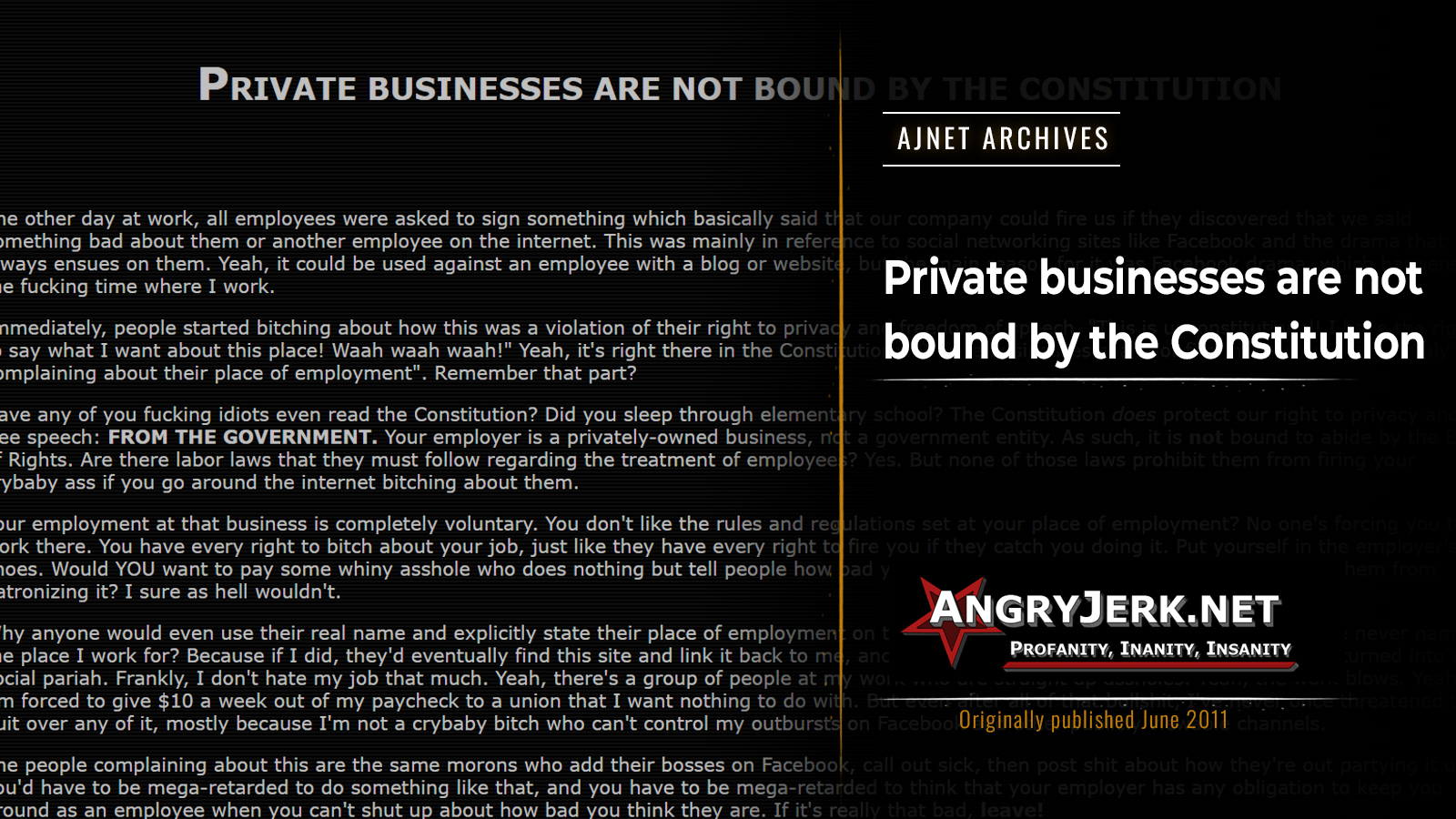
Back in June of 2011, I wrote an article called Private businesses are not bound by the Constitution.
The article was pretty straightforward. A bunch of my coworkers were complaining that our employer’s social media policy violated their First Amendment rights, and I explained why they were wrong. The Constitution protects you from the government restricting your speech. It doesn’t mean a privately owned company has to tolerate you publicly trashing them while continuing to sign your paycheck.
Fifteen years later, I still stand by the basic argument.
The whole thing started at my old ShopRite job. One of the employees had gotten in trouble for badmouthing the company on Facebook, which wasn’t exactly shocking because Facebook drama was practically a second job for some of the people working there. There’d already been a bunch of workplace bullshit spilling onto social media, so management eventually decided they’d had enough and implemented a rule prohibiting employees from talking shit about ShopRite or their coworkers online.
This was 2011, when Facebook was still the center of everybody’s digital universe. Half the people I worked with seemed to spend their free time posting vague status updates about one another, starting arguments, and then coming into work the next day to continue whatever stupid feud they’d started online.
Naturally, the people most involved in this behavior were also the loudest people complaining about the new rule.
“It’s unconstitutional!”
“They’re violating our freedom of speech!”
“They can’t tell me what I’m allowed to post!”
Yes, they could.
The First Amendment doesn’t require your private employer to provide you with a platform for whatever stupid thing you feel like saying. It doesn’t require Facebook, X, Reddit, YouTube, or any other privately operated website to let you post whatever you want either. There are obviously separate laws regulating what employers and businesses can and can’t do, but “my constitutional rights” isn’t a magic phrase that overrides the rules of every privately owned organization you interact with.
I’ll add a little more nuance today than I did in 2011 because employment law is complicated. Employees can have legal protections when discussing wages, working conditions, union activity, discrimination, whistleblowing, and other protected matters. There are also state laws limiting how employers can monitor employees outside of work.
None of that changes the point I was making.
In fact, as a management consultant, I’ve seen the opposite extreme firsthand.
I once had a client tell me that one of their conditions of employment was that employees had to grant the company access to their personal social media accounts. Not just whatever was publicly visible. They wanted access to the accounts themselves.
My first piece of advice was to stop doing that immediately because it was fucking insane.
My second piece of advice was to fire whoever was providing their legal advice, because their lawyers should’ve stopped that policy long before I ever heard about it. There are laws specifically restricting employers from demanding private social media credentials, and even setting the law aside for a moment, why the hell does your employer need access to your personal Facebook account?
There’s a reasonable concern about employees damaging a company’s reputation, and then there’s behaving like an obsessive boyfriend demanding to look through somebody’s phone.
I absolutely believe employers should exercise some restraint when it comes to monitoring what employees do outside of work. If Francine from accounting goes home and posts that she thinks the Eagles suck, I don’t care. If she says the President is an asshole, I don’t care. If she posts some stupid meme that I don’t find funny, I don’t care. I’m paying Francine to do accounting, not to share my opinions.
But if Francine starts posting that the company is a scam, telling customers not to do business with us, revealing confidential information, or otherwise actively damaging the company’s reputation, then we’ve got a problem.
Employees shouldn’t expect an unlimited right to publicly sabotage their employer without consequences. At the same time, the punishment should fit the crime. Somebody shouldn’t lose their livelihood because they posted “My boss is an asshole” after a bad day. I’ve had bosses who were assholes. I’m sure I was also somebody’s asshole boss at some point too.
There was actually one part of ShopRite’s rule that bothered me back in 2011, even though I never mentioned it in the original article.
Facebook didn’t have the identity verification systems it has today. There was nothing stopping somebody from creating an account using another employee’s name and photograph, posting a bunch of horrible shit about ShopRite, then anonymously reporting the account to management.
I brought this possibility up to our store director.
He didn’t give two shits.
His response basically amounted to: agree to the policy or leave.
I can’t say I didn’t briefly consider demonstrating the flaw in his logic. If this had happened in 2007, there’s a decent chance I would’ve created a fake account pretending to be him just to prove my point. Thankfully, 2011 AJ was slightly more mature than 2007 AJ.
Slightly.
Instead, I settled for being a smart ass.
I’d post things like, “ShopRite sucks… if you hate low prices,” or “ShopRite blows… the competition out of the water.”
The workplace snitches immediately reported these posts to my boss. My boss wasn’t amused. She scolded me and told me to grow up.
Looking back at the original article today, I actually think it held up substantially better than a lot of the garbage I wrote during that era. If anything, the issue has become considerably more relevant because social media has become more political, more invasive, and far more capable of destroying somebody’s real-world life.
I had to deal with exactly this problem myself last year.
One of my employees, Sharon, is very politically opinionated. If you read her recent AJnet article, that probably won’t come as much of a surprise. She’s particularly outspoken when it comes to the political right.
When Charlie Kirk was shot and killed, Sharon posted something about him on social media. I’m not going to repeat what she said here, but let’s just say it wasn’t a touching memorial.
I didn’t like Charlie Kirk either, but I thought what Sharon posted was disgusting. Whatever disagreements I had with the guy, I don’t think he deserved to die.
I also didn’t know she’d posted anything because I don’t really use social media.
I found out when complete strangers started contacting our company.
Someone had dug through Sharon’s online presence, found her LinkedIn account, discovered where she worked, and circulated that information among people who wanted her punished. Suddenly our phones started ringing with strangers asking to speak directly with Sharon so they could personally tell her what they thought of her.
Once we figured out what was happening, we stopped putting the calls through.
Then came the emails.
Over the next several days we received close to 100 calls and messages from people demanding that we fire her. Our Google Business page also got hit with fake negative reviews from people who’d never done business with us. Thankfully, Google figured out what was happening and removed them.
I’ve known Sharon for 16 years. I know what kind of person she is, and despite our political disagreements, she’s not a bad person. Her work performance has always been stellar, she wasn’t speaking on behalf of the company, and nothing on the post identified her as representing us. The only reason anybody connected her comments to our company was because strangers went digging through her personal information until they found her employer.
I talked it over with Sam and Steph, and all three of us agreed that we weren’t firing her.
Two clients eventually contacted us after seeing the post and demanded that we terminate her. I told them, in more professional language, to pound sand. Our company supports people’s right to have political opinions, including opinions the owners don’t agree with.
Both clients decided they no longer wanted to use our services.
Fine by me. Your shitty restaurant group and automotive franchise won’t be missed, assholes.
I did sit Sharon down afterward. I told her that I thought her post had gone too far and that most employers would’ve fired her for considerably less (Asterios Kokkinos losing his job during the whole Maddox and Dick Masterson mess comes to mind here). Whether you think these types of firings are justified or not, they happen all the fucking time.
Sharon wasn’t fired, suspended, written up, or otherwise punished. I simply told her she needed to understand that what she posted publicly could spill into the real world, especially when lunatics on the internet decide to make somebody their target.
She agreed and cleaned up some of her social media.
That’s where my opinion has evolved a little since 2011.
I think employers have a moral obligation to give employees a reasonable amount of freedom outside of work. I don’t think they have a constitutional obligation to do so.
Those are two completely different arguments.
Sharon had every right to say what she said about Charlie Kirk. I had every right to think what she said was fucking disgusting. The people bombarding our office had every right to tell me they wanted her fired, and I had every right to tell them to fuck off.
Free speech doesn’t mean freedom from every possible consequence. It also doesn’t mean an internet mob should get veto power over somebody else’s employment.
Employees need to exercise some common sense online because most employers aren’t going to take the approach we did. If you’ve got your employer listed on your profile, understand that anything you post can potentially come back to them. Even if you don’t have them listed, some deranged asshole can probably find the connection if they’re sufficiently motivated.
You shouldn’t have to turn yourself into a politically neutral corporate robot just because you have a job. Employers shouldn’t be combing through every employee’s Facebook account looking for reasons to punish them either.
But there’s a difference between believing employers should respect your personal speech and believing they’re violating the Constitution if they don’t.
Fifteen years later, people still get those two things confused.
Oh, and if you’re dumb enough to add your boss on Facebook, call out sick, then post pictures of yourself partying all day, I haven’t changed my position on that at all.
Whatever happens next is your own damn fault.

More from Angry_Jerk



Don't miss any new posts. Join AJnet Magazine's mailing list and receive updates straight to your inbox once a week!