
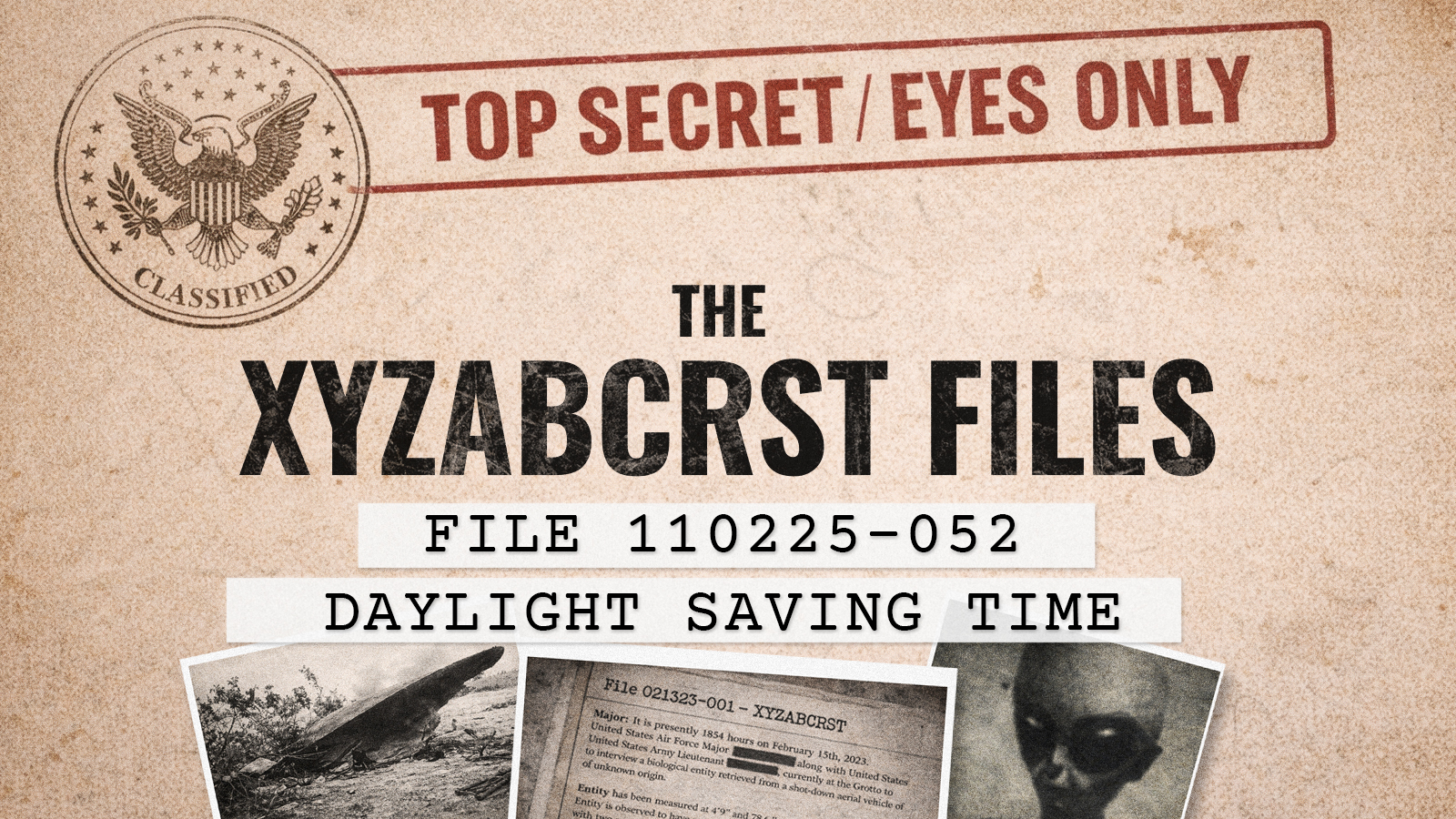
In February of 2023, an unidentified flying object was shot down over Lake Huron and retrieved by the US military. Its sole occupant, an extraterrestrial biological entity named Xyzabcrst, was taken to an undisclosed military facility codenamed “The Grotto” and interviewed by base personnel. The transcripts of these interviews have been provided by an AJnet Organization operative working inside a three letter agency.
The following is a transcript of an interview with Xyzabcrst regarding Daylight Saving Time.
Major: It is currently 0917 hours on November 2nd, 2025. I’m Major [REDACTED], here at the Grotto with Lieutenant [REDACTED] and extraterrestrial biological entity Xyzabcrst.
Xyzabcrst: Your clocks are wrong.
Major: What?
Xyzabcrst: Your clocks are wrong. Every clock in this facility is displaying a time one hour earlier than it displayed yesterday.
Major: Oh. Daylight Saving Time ended last night.
Xyzabcrst: What is Daylight Saving Time?
Lieutenant: We change the clocks twice a year.
Xyzabcrst: Why?
Major: It’s a little complicated.
Xyzabcrst: Of course it is.
Major: During part of the year, we move the clocks forward one hour so that there is more daylight later in the evening. Then in the fall we move them back.
Xyzabcrst: You move time?
Major: No, we move the clocks.
Xyzabcrst: Then there is not more daylight.
Major: Technically, no.
Xyzabcrst: The amount of daylight is determined by the rotation of your planet and its position relative to your star.
Major: Correct.
Xyzabcrst: Changing the numbers displayed on a clock does not alter your planet’s rotation.
Major: Correct.
Xyzabcrst: It does not alter the position of your planet relative to your star.
Major: No.
Xyzabcrst: It does not create additional daylight.
Major: No.
Xyzabcrst: Then why is it called Daylight Saving Time?
Major: Because the idea is that you’re shifting an hour of usable daylight from the morning to the evening.
Xyzabcrst: You just said that you are not actually moving the daylight.
Major: We’re not physically moving it.
Xyzabcrst: Then you are not saving it either.
Major: Not literally.
Xyzabcrst: Your explanation has already failed.
Lieutenant laughs.
Major: The basic idea goes back a long time, but modern Daylight Saving Time became widely used during the First World War. Governments wanted to reduce energy consumption by having people make better use of natural daylight instead of artificial lighting.
Xyzabcrst: When was your First World War?
Major: 1914 to 1918.
Xyzabcrst: More than one hundred years ago?
Major: Yes.
Xyzabcrst: What did humans use for artificial lighting at that time?
Major: Mostly electric lights, although electricity wasn’t as universally available as it is now.
Xyzabcrst: And your civilization has changed considerably since then?
Major: Obviously.
Xyzabcrst: Your energy production has changed?
Major: Yes.
Xyzabcrst: Your lighting technology has changed?
Major: Yes.
Xyzabcrst: Your work schedules have changed?
Major: Yes.
Xyzabcrst: Yet you continue changing every clock on your continent twice each year because governments during a primitive industrial war believed it might reduce lighting costs?
Major: When you put it that way—
Xyzabcrst: Is there another way to put it?
Major: There have been other arguments for keeping it over the years.
Xyzabcrst: Such as?
Lieutenant: Farmers like it.
Major: Actually, that’s a myth.
Xyzabcrst slowly turns its head toward the Lieutenant.
Lieutenant: What?
Major: Farmers have historically been some of the biggest opponents of Daylight Saving Time.
Lieutenant: Seriously?
Major: Yes. Crops and livestock don’t care what the clock says. Farmers had to adjust around everybody else suddenly changing their schedules.
Xyzabcrst: Wait.
There is silence for approximately five seconds.
Xyzabcrst: Lieutenant [REDACTED] believes that your civilization changes its clocks twice every year because farmers requested it.
Lieutenant: That’s what I always heard.
Xyzabcrst: But the farmers did not request it.
Major: Generally, no.
Xyzabcrst: In fact, many farmers opposed it.
Major: Yes.
Xyzabcrst: Yet humans continue repeating the claim that Daylight Saving Time exists for farmers.
Major: Yes.
Xyzabcrst: Why?
Major: It’s just one of those things people hear and repeat.
Xyzabcrst: Without determining whether it is true?
Lieutenant: Pretty much.
Xyzabcrst: Your species has global access to nearly the entirety of its accumulated knowledge through small electronic devices carried in your pockets.
Lieutenant: Yeah.
Xyzabcrst: Yet you still repeat incorrect information because someone told it to you once.
Lieutenant: Also yeah.
Xyzabcrst: Fascinating.
Major: Look, there are modern arguments for Daylight Saving Time too. Some people like having more daylight after work. Businesses can benefit from people being outside later. There have also been arguments about energy conservation and traffic safety.
Xyzabcrst: Then why did you change the clocks back last night?
Major: Because Daylight Saving Time ended.
Xyzabcrst: I understand that. Why end it if having more daylight in the evening is beneficial?
Major: Because during the winter the sun rises later, so permanent Daylight Saving Time would mean darker mornings.
Xyzabcrst: Then your solution is to move the clocks again.
Major: Right.
Xyzabcrst: Rather than simply adjusting the operating hours of businesses and institutions when necessary.
Major: That would be considerably more complicated.
Xyzabcrst: More complicated than changing the official time for hundreds of millions of people?
Major: Apparently.
Xyzabcrst: Do all humans change their clocks?
Major: No.
Xyzabcrst: Of course not.
Major: Some countries don’t use Daylight Saving Time. Even here in the United States, there are places that don’t observe it.
Xyzabcrst: Different areas of the same country use different systems?
Major: Yes.
Xyzabcrst: So while traveling across your country, a human can cross an invisible geographic boundary and the time changes?
Major: Well, that happens with regular time zones too.
Xyzabcrst: Do not introduce another problem.
Lieutenant laughs.
Xyzabcrst: When did your society decide that this was the best possible system?
Major: Nobody really decided that. It developed over time.
Xyzabcrst: That is becoming a recurring explanation for human behavior.
Major: What do you mean?
Xyzabcrst: Whenever I discover something your species does that appears irrational, I ask why you do it. You explain that humans began doing it many generations ago for reasons that are no longer particularly relevant, nobody can agree whether it is still useful, large numbers of humans dislike it, and yet you continue doing it because changing it would be inconvenient.
Lieutenant: That’s actually a pretty good summary of a lot of things.
Major: He’s not entirely wrong.
Xyzabcrst: Do humans enjoy changing the clocks?
Major: Most people I know complain about it.
Xyzabcrst: Does your government require it?
Major: In most states, yes.
Xyzabcrst: Have humans attempted to stop doing it?
Major: Many times.
Xyzabcrst: And?
Major: We’re still doing it.
Xyzabcrst stares silently at the Major.
Major: What?
Xyzabcrst: I am attempting to determine whether there is some element of this that I have failed to understand.
Major: Have you come up with anything?
Xyzabcrst: No.
Lieutenant: So what do you think of Daylight Saving Time?
Xyzabcrst: I think it is completely irrational.
Major: Fair enough.
Xyzabcrst: Your planet receives a predictable amount of sunlight based upon its rotation and orbit. Rather than organizing your daily activities around this natural cycle, your species collectively changes the numerical designation of the hour twice each year, inconveniences itself, argues about whether the practice should continue, invents false explanations involving farmers, and then fails repeatedly to stop doing it.
Major: That’s one interpretation.
Xyzabcrst: What is the other interpretation?
Major: I don’t have one.
Xyzabcrst: I have traveled across multiple star systems. I have encountered civilizations with customs that your species would find incomprehensible. I have observed beings who consume their own offspring, species that communicate exclusively through chemical secretions, and a civilization that elects its leaders based upon the geometric patterns produced by their digestive waste.
Lieutenant: Seriously?
Xyzabcrst: Yes.
Lieutenant: How does that work?
Xyzabcrst: It is not relevant.
Lieutenant: I kind of want to hear about it.
Xyzabcrst: My point is that even their behavior can be explained logically within the context of their biology and culture.
Major: And Daylight Saving Time can’t?
Xyzabcrst: No.
There is silence for approximately eight seconds.
Xyzabcrst: I am beginning to believe that some human behavior may simply be beyond my understanding.
Major: I’m not sure whether to be offended by that.
Xyzabcrst: You should be.
The recording ends.

More from Chick Styles



Don't miss any new posts. Join AJnet Magazine's mailing list and receive updates straight to your inbox once a week!
Ahem
I have discovered a continuity error in your transcripts, sir.
In File 110325-002 – The Political System, which is purported to have taken place on November 3rd, 2025, Xyzabcrst says that he hasn’t spoken to the Major and the Lieutenant in almost a year.
Yet, this very transcript says that the conversation within it occurred just the day before, on November 2nd, 2025. How could this be so, given the timeline of events stated by Xyzabcrst in File 110325-002?
Explain this inconsistency at once, or I shall deem this transcript, and all other Xyzabcrst Files transcripts, fraudulent.
The US Military has time travel.