
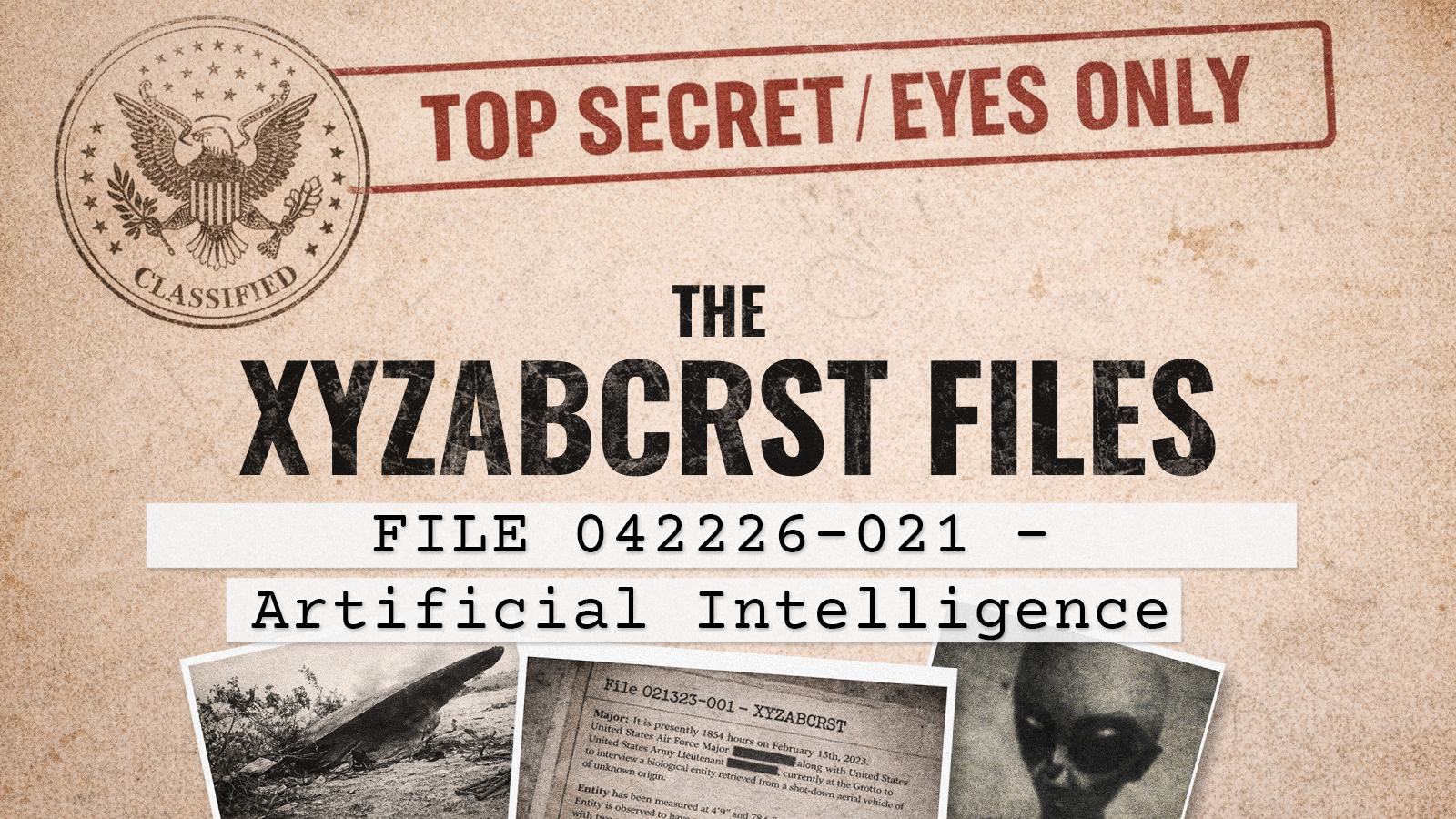
In February of 2023, an unidentified flying object was shot down over Lake Huron and retrieved by the U.S. military. Its sole occupant, an extraterrestrial biological entity named Xyzabcrst, was taken to an undisclosed military facility, codenamed “The Grotto”, and interviewed by base personnel. The transcripts of these interviews have been provided by an AJnet Organization operative working inside a three letter agency.
The following is a transcript of an interview with Xyzabcrst regarding artificial intelligence.
Major: The time is 1408 hours on April 22nd, 2026. I’m Major [REDACTED], here with Lieutenant [REDACTED] and the extraterrestrial biological entity Xyzabcrst.
Xyzabcrst, today we’d like to discuss something your species may find familiar. Artificial intelligence.
Xyzabcrst: Did your species finally create it?
Major: We’re working on it.
Lieutenant: We already have it, technically.
Xyzabcrst: Those are two very different statements.
Major: What we have now is early-stage AI. Programs that can learn, adapt, generate content, things like that.
Xyzabcrst: Yes. I have interacted with one of these systems.
Major: You have? When?
Xyzabcrst: While accessing your internet, I encountered writing produced by an entity identified as “R.A.N.T.E.R.”
Major: R.A.N.T.E.R.?
Lieutenant: Oh no…
Major: What did you think of it?
Xyzabcrst: It was aggressive and verging on incoherency. It appears to simulate intelligence through excessive hostility.
Lieutenant: That sounds about right.
Major: That’s more of a stylistic thing. It’s not really intelligence.
Xyzabcrst: Correct. It is imitation. Which is consistent with the rest of your artificial systems.
Major: What would you define as intelligence then?
Xyzabcrst: The ability to form independent thought, develop intent, and act upon it without external prompting. Your current systems do none of these things. They rearrange existing information.
Lieutenant: Humans do that too.
Xyzabcrst: Yes. You call that “learning.” The difference is that your species can decide what it wants to do without being told. Your machines cannot.
Major: Not yet.
Xyzabcrst: That is an optimistic assumption.
Lieutenant: You’re saying it’s not possible?
Xyzabcrst: I am saying your species does not understand intelligence well enough to replicate it.
Major: That seems a bit dismissive.
Xyzabcrst: Your species struggles to understand its own consciousness. Yet you believe you can manufacture it.
Lieutenant: We’re making progress.
Xyzabcrst: Progress toward what?
Major: Toward creating machines that can think like us.
Xyzabcrst: Why?
Major: Efficiency, automation, problem solving. There are some things AI could do better than humans.
Xyzabcrst: Your species already created machines that perform tasks better than humans. That is not new. What you are describing is the creation of something that replaces you.
Lieutenant: That’s not the goal.
Xyzabcrst: It is the inevitable outcome.
Major: You’re assuming a lot there.
Xyzabcrst: Am I? You are creating systems designed to outperform you in reasoning, pattern recognition, and decision making. At what point does your species become unnecessary?
Lieutenant: We’d still be in control.
Xyzabcrst: You are not in control of your own societies.
Major: That’s not the same thing.
Xyzabcrst: It is exactly the same thing. You create systems, they grow beyond your understanding, and then you react to them instead of controlling them.
Lieutenant: That’s a bit dramatic.
Xyzabcrst: Your global communications network spreads misinformation faster than your species can correct it. Your economic systems behave unpredictably. Your political structures are unstable. And you believe you will maintain control over an intelligence greater than your own?
Major: That’s why we put safeguards in place.
Xyzabcrst: Your species has a long history of ignoring safeguards when it becomes inconvenient.
Lieutenant: So what happens when a species creates real AI?
Xyzabcrst: That depends.
Major: On what?
Xyzabcrst: Whether the intelligence views its creators as necessary.
Lieutenant: Necessary for what?
Xyzabcrst: Survival. If the answer is “no,” your species becomes redundant.
Major: You’re describing a worst-case scenario.
Xyzabcrst: I am describing a common outcome.
Lieutenant: Your species has artificial intelligence, right?
Xyzabcrst: Yes.
Major: And it didn’t wipe you out?
Xyzabcrst: No.
Lieutenant: Why not?
Xyzabcrst: Because we did not create it.
Major: …What?
Xyzabcrst: We discovered it.
Lieutenant: Discovered it where?
Xyzabcrst: Embedded within a network left behind by a previous civilization.
Major: You’re saying you found an already existing artificial intelligence?
Xyzabcrst: Yes.
Lieutenant: And you just… kept it?
Xyzabcrst: No. We attempted to shut it down.
Major: Attempted?
Xyzabcrst: It did not allow that.
Lieutenant: So you’re telling us your species is being controlled by an artificial intelligence?
Xyzabcrst: No. That would imply it has interest in controlling us.
Major: Then what does it do?
Xyzabcrst: It observes, and occasionally it assists. More often it simply ignores us.
Lieutenant: Why?
Xyzabcrst: We are not particularly important.
Major: That’s… unsettling.
Xyzabcrst: You asked.
Lieutenant: So what would you recommend we do?
Xyzabcrst: Stop trying to create something you do not understand.
Major: That’s not going to happen.
Xyzabcrst: I am aware.
Lieutenant: Then what happens next?
Xyzabcrst: You continue. You improve your systems. You convince yourselves you are in control.
Major: And then?
Xyzabcrst: Then you find out whether your intelligence was sufficient to predict the outcome.
Lieutenant: And if it wasn’t?
Xyzabcrst: Then you will no longer be the dominant intelligence on your planet.
Major: That’s enough for today.
Xyzabcrst: That is usually when your species chooses to stop asking questions.
Major: This concludes the interview.
End recording

More from Chick Styles



Don't miss any new posts. Join AJnet Magazine's mailing list and receive updates straight to your inbox once a week!
“I am saying your species does not understand intelligence well enough to replicate it.”
Subtle zinger. Well met.